


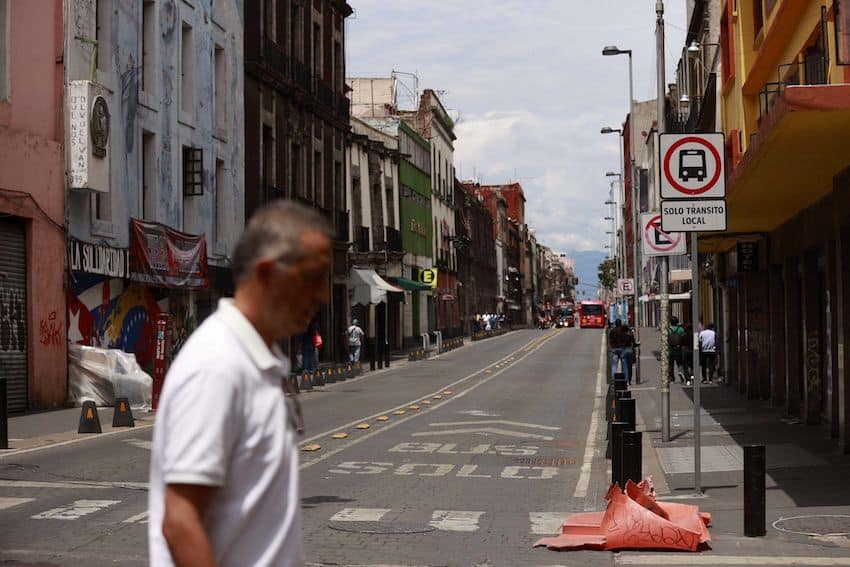
The federal government has denied that it paid 800 million pesos (US $46 million) to Section 22 of the CNTE teachers’ union in exchange for it agreeing to take down its protest camp in the historic center of Mexico City.
Teachers affiliated with the Oaxaca-based Section 22 of the dissident union began taking down their tents on Friday night. A large protest camp set up by teachers demanding better pay and the abrogation of a 2007 reform that changed their pension system remained in the historic center of the capital for 19 days.
Teachers’ union defaces World Cup statues, installs sit-in within blocks of Zócalo
Members of the CNTE’s Section 22 voted last Thursday in favor of ending their protest in the capital, although they remained committed to fighting for a 100% pay rise and the revocation of the 2007 ISSSTE (State Workers’ Social Security Institute) Law, which changed their pension system and will leave them — they say — considerably worse off in retirement.
While the general secretary of Section 22, Yenny Aracely Pérez Martínez, said late last week that an “economic offer” from the federal government wouldn’t go to the union division she leads, and wasn’t related to any decision to take down the protest camp, assertions were made, including on social media, that the Sheinbaum administration had paid Section 22 to dismantle its encampment.
Education Minister Mario Delgado denied that was the case, telling reporters on Saturday that the 800 million pesos would go to schools and be used to create additional teaching positions in places where more teachers are needed.
He said that the money was coming from the government’s education budget.
On Monday, President Claudia Sheinbaum stressed that the government’s 800-million-peso allocation to schools in Oaxaca wasn’t going to the CNTE.
“Those 800 million pesos have absolutely nothing to do with the CNTE, nothing,” she told reporters at her Monday morning press conference.
“It’s for the education of girls and boys in Oaxaca,” Sheinbaum said.
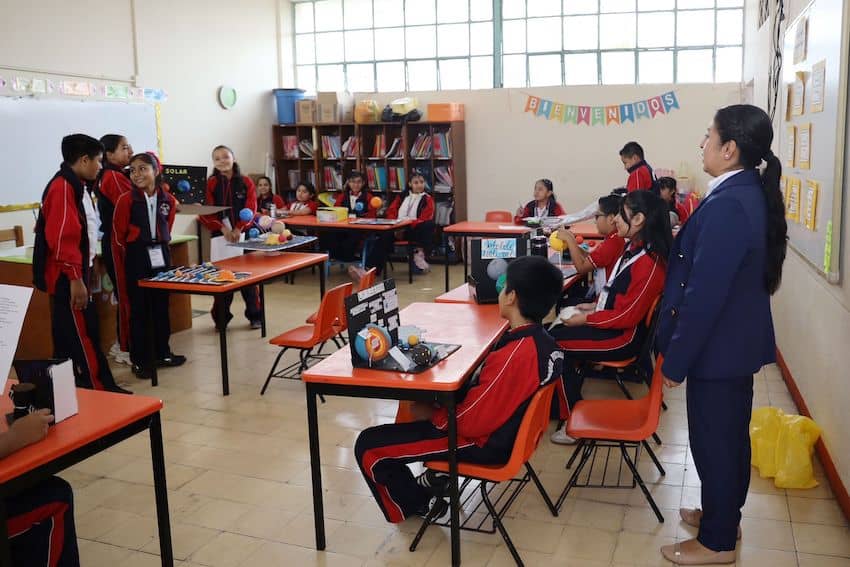
She said the money would be used to create new teaching positions in the southern state and to make “improvements” to schools.
“Last year, for example, we reached an agreement for there to be computers and printers in all the schools that need them,” Sheinbaum said.
The 800-million-peso allocation “isn’t given to the union so that the union gives it to the schools,” she stressed.
The money is given “directly to the schools,” Sheinbaum said.
“… This idea that ‘this money is going to the union’ is mistaken, it’s false,” she said.
“It’s to improve education in Oaxaca for the girls and boys in Oaxaca,” Sheinbaum said.
A ‘historic’ protest comes to an end
The federal and Mexico City governments, business owners in the historic center of Mexico City — many of whom have incurred heavy economic losses due to the teachers’ protest — and at least some World Cup fans are no doubt relieved that the CNTE camp has been dismantled. The encampment was located near Mexico City’s central square, the Zócalo, which is currently hosting FIFA’s official World Cup Fan Festival.
Parents of more than 1.4 million students affected by teacher strikes — in Oaxaca and in several other states — are also no doubt happy that their children will be able to go back to school.
As for the protesting teachers, they will “reorganize” for the next stage of their fight for better pay, better conditions and the repeal of the 2007 ISSSTE law, according to Pérez, the leader of the CNTE’s Section 22.
“We came out to demand a decent retirement, and during these days the intransigence of the federal government was made visible,” she said.
She said that “the fight” teachers have undertaken through recent protests in Mexico City and other parts of the country “has been historic.”
“Not just because we denounced a government that isn’t on the side of workers, but also because we denounced the administrators of retirement funds [AFORES]. We’ve made national and international headlines, and achieved the goal of raising awareness that there is not a [fair] retirement system for all workers in the country,” Pérez said.
Teachers are not going home because they have been defeated, but rather to “reorganize,” she said.
“… We will return with more strength,” Pérez said.
For his part, Pedro Hernández Morales, a CNTE leader in Mexico City, said that the decision to end this stage of the fight for better pay and conditions is not akin to being “defeated.” According to the newspaper La Jornada, Hernández said that CNTE-affiliated teachers will “return with greater strength, composure and intelligence.”
Sheinbaum has said that protesting teachers have “legitimate demands,” while stressing that it is not possible for the government to meet all of them. She has said on repeated occasions that the government can’t meet all of the demands for budgetary reasons. Via the Education Ministry and the Interior Ministry, the Sheinbaum administration has engaged in dialogue with the CNTE in recent weeks as it sought to reach a resolution that would bring the protests to an end and get teachers to return to their classrooms.
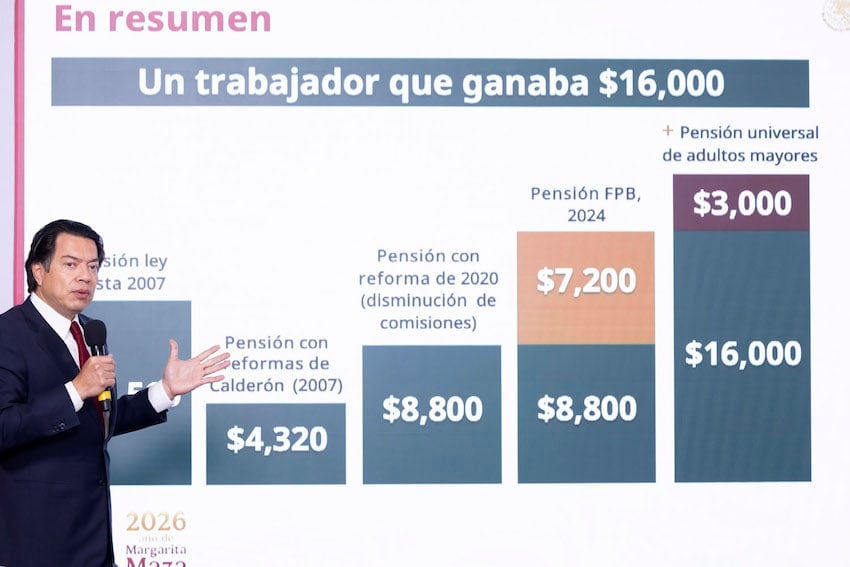
Delgado has sought to show that teachers have benefited from government policies in a range of ways in recent years, including due to significant salary increases, while ISSSTE chief Martí Batres said earlier this month that the creation of a common pension fund for teachers of the kind that existed before the 2007 reform is unaffordable, but the Pensionissste scheme could be “developed progressively” in order to become a better alternative to individual retirement accounts.
With reports from El Financiero, López-Dóriga Digital, El Universal and La Jornada
