


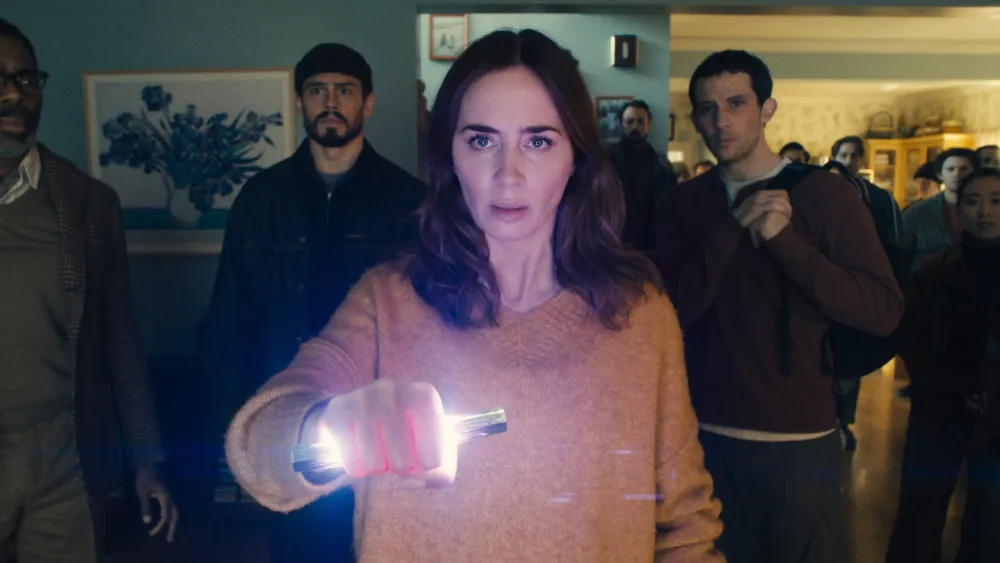
John Williams‘ music for “Disclosure Day” marks his 30th score for director Steven Spielberg, dating back more than half a century to their first film together, “The Sugarland Express” in 1974.
It could be Williams’ final score for the movies. No one has formally stated that, and in fact Spielberg says he’s already spoken to Williams about doing their 31st together.
But Williams is now 94, and hinted three years ago that his score for Spielberg’s “The Fabelmans” would likely be his swansong. The director talked him into doing “Disclosure Day” even after Williams suggested four other composers as possible successors.
Williams is no longer doing press interviews (“preferring to marshal his energies to focus on writing obligations,” says a spokesman) and Spielberg was not available for this story.
Multiple sources say Spielberg wanted a Williams score for “Disclosure Day” so badly that he made it as easy as possible for the composer, scheduling seven recording sessions over a six-month period to give him the necessary time to conceive and record all of the music.
Most film sessions are done over a week or two, and many composers have only a few weeks to compose a complete film score. Williams, who has faced unspecified “health challenges” over the past two years and is now only seen in public in a wheelchair, tackled “Disclosure Day” with surprising energy, sources report.
Williams began writing last summer. An orchestra of 96 players was assembled, with the first recording date at Sony (in the recently renamed “John Williams Music Building”) on Sept. 11, 2025.
It was a traditional symphonic ensemble, sources report, although one especially dark cue demanded no fewer than four bassoons; the keyboards included not just piano and celeste but also synthesizer; and there were two harps instead of the usual one.
And while the film’s credits say that the score was “orchestrated and conducted by” Williams along with longtime colleagues William Ross and Randy Kerber, those closest to the maestro insist that Williams orchestrated the entire score and conducted much of it, usually while seated but also standing at times.
Anyone who has ever witnessed Williams at a recording session will tell you that he is always very precise about orchestral detail, knowing exactly how every note should sound. Ross and Kerber did occasional “adaptations” of Williams’ material to accommodate revisions in the film, sources say.
Recording continued through the fall and winter: two more sessions in October, two in December, one in January 2026 and a final session on Feb. 20. The extended schedule allowed the composer ample time to compose, so the score developed as the months rolled on.
“John was in amazing spirits,” says one musician, “always so gracious and humble. He was very acutely aware of rhythmic flaws and nuances, and sometimes obsessed a little. Spielberg was delighted with everything.”
The director took an active role throughout, sources say. “He had a lot of input,” says another musician. “That relationship felt so special to witness. There was even a moment when he made a musical suggestion and they tried something a little bit different. They actually ended up going with that. It just felt like an encapsulation of their relationship, how well they know each other, and how well they understand each other’s craft. It was almost magical.”
On Dec. 19 the orchestra was joined by a 30-voice female choir. They were evenly divided into sopranos and altos, plus a solo voice for a handful of cues. The choice of singer required some experimentation and auditions by a handful of singers, including children, but the final choice (credited in the film as “vocal soloist”) was Holly Sedillos, whose voice can be heard briefly in the film but more prominently during the end credits.
Interestingly, the choir recorded their wordless vocal sounds together with the orchestra, another unusual aspect of the sessions. Most composers record choir separately and mix them with orchestra later; Williams prefers everyone in the same room at the same time.
All of the sessions were closed and attended by very few. Spielberg was in the cavernous studio, just a few feet away from Williams, along with music editor Ramiro Belgardt; together they shared a small screen and could watch the film unspool as cues were recorded.
No film was projected onto the big screen behind the orchestra, as would happen under normal circumstances; that way no musician or studio technician could see any of the (then) super-secret footage.
Over the course of seven sessions, Williams recorded more than two hours and 20 minutes of music. The final film contains 82 minutes of score. Some of the extra music was reserved for the soundtrack album.
Spielberg is quoted in the film’s press notes as saying, “‘Disclosure Day’ is probably the most restrained score he has ever written for one of our collaborations—at least until it is not. But until those moments, he holds back in a way that is subtle and beautiful and enriches the experience. It is like he is accompanying the film from slightly behind it, pushing it forward.”
Much of the score is mood-setting, but in an undeniably sophisticated way. Williams’ main theme is contemplative and ultimately powerful, tinged with Americana (as much of the film takes place in middle America).
Eerie string passages and occasional dissonances subtly harken back to his score for “Close Encounters of the Third Kind,” which now seems a precursor to this film. Darker moments reflect the government forces trying to stop the release of secret UFO footage; more fast-paced ones help propel Margaret (Emily Blunt) and Daniel (Josh O’Connor) on the run throughout the film.
At the end of the final session, cake and champagne were served behind engineer Shawn Murphy’s mixing board, with Spielberg remarking, “this is our 30th movie together, and we’re still in love,” and Williams responding with a line he’s used before: “Steven’s a man you can’t say no to.”
This was where Spielberg told the small group that he has an idea for his next film, “and John just said yes.” Adds a Williams associate: “So long as he’s able, he’ll do the next movie.”
“Disclosure Day” is the 105th theatrical film to feature an original John Williams score. His first was in 1958, and since that time he has been honored with 54 Oscar nominations, winning five; and 76 Grammy nominations, winning 27.
His latest concert composition, the six-minute “Bravo Gustavo,” was debuted last week by the Los Angeles Philharmonic at Disney Hall as Gustavo Dudamel, a close friend of Williams, prepares to depart for his new position with the New York Philharmonic.
Mike Knobloch, president, NBC-Universal Music and Publishing, told Variety after Monday’s New York premiere: “John and Steven were allowed to take time, the months that they needed from September to almost March, a rare luxury that most filmmakers wouldn’t get.
“This legendary composer, the godfather of modern film scoring, did what we hoped he would do, which was to create a distinctive, unique, original and transcendent score for this Spielberg movie in the way that only he can. It’s a character in the movie—exhilarating, scary, poetic.”
