
City Winery owner Michael Dorf said he gets letters all the time from performing rights organizations (PROs) like BMI, SESAC and AllTrack when he pushes back on the blanket licensing practice that requires live music venues — as well as other businesses that play music — to pay a set fee for the songs being played in their establishments. The money collected from the businesses goes to the PROs, that then distribute the funds to the songwriters they represent.
But Dorf, who also owns Michael Dorf Presents and founded the original Knitting Factory venue in New York, said these letters are in response to him asking the individual PROs to specify what songs of theirs were played on his stage. The letter in hand from AllTrack, Dorf explained from the annual National Independent Venue Alliance conference in Minneapolis earlier this week, threatened fines of up to $150,000 per track used if he does not obtain the appropriate license.
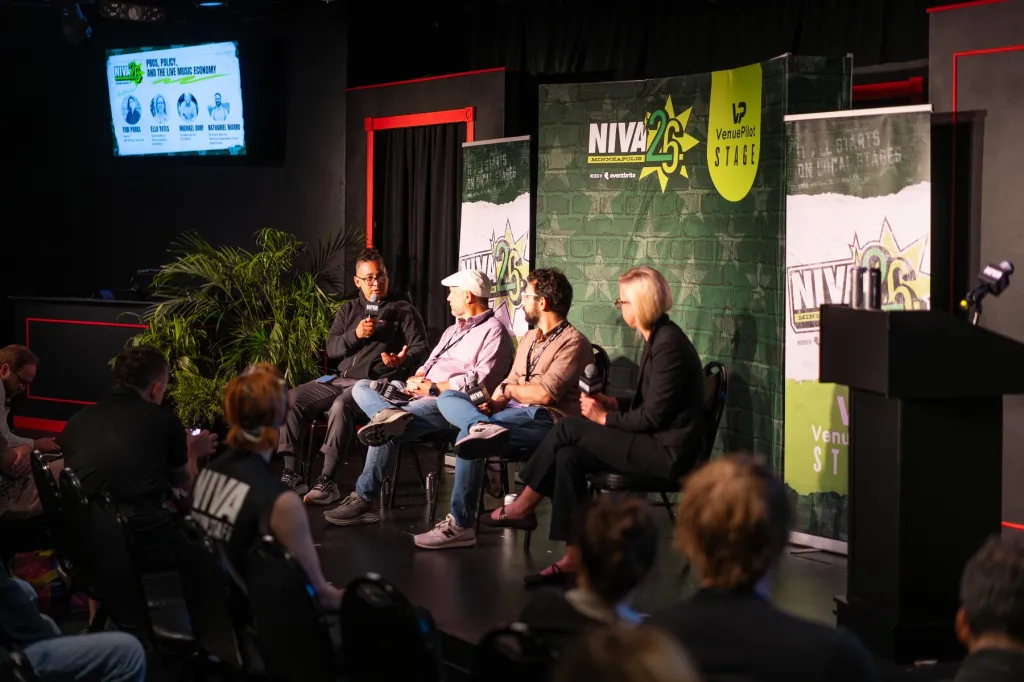
“This is mafioso, thug-like practices,” Dorf tells the room of independent venue owners, promoters, talent agents and more during the PROs, Policy, and the Live Music Economy panel at NIVA’26. “This is an outdated law, and it’s being abused. It’s making everyone nervous that they are going to get sued.”
“My question would be, is it the law itself that is the problem or is it the way the PROs are leveraging it?” said Ella Yates, senior adviser to the House Judiciary Committee at the conference. Yates started her career in Congress in 2016 working for then-Congressman Doug Collins during the Music Modernization Act negotiations. “Because they’re suggesting you can’t go work by work. ‘You have to get this blanket license. Sorry, deal with it.’ And that’s not really a federal law. That’s just a business practice.”
The panel — moderated by xBK Live venue owner and Tour Tech co-founder Tobi Parks — was set to discuss the concerns independent venues are having with the practice of blanket licensing used by PROs in the U.S. and how that bloating cost is hurting both the artists and the venues they tour in. The topic was a looming concern for NIVA members attending the conference from June 7-10 throughout independent venues in the city.
Nathaniel Marro, executive director of the National Independent Talent Organization (NITO), told the audience that he believes PROs work for 85% to 90% of what artists need to get paid for the use of their work, but that the blanket licensing practice seems like “a very serious hole in the bucket.” Depending on the show deal, the PRO fees can be coming out of the artist’s pocket. Marro explained that NITO conducted studies in 2025 that found that some artists were paying upward of $15,000 on tour to PROs and receiving just $26 back for playing their own works.
“When we talk about the blanket licensing model and what PROs have to do, their job is immense,” said Parks. “They have to license everything from the local laundromat to the movie theater, to the radio stations, to all of our venues, and figuring out how to collect all of those royalties to make sure that songwriters get compensated — which is what we all want to have happen — is an enormous task.”
In the U.S., a PRO blanket license for a live music venue works to ideally cover the use of any work being played or performed at a show. Artists can be signed up to a handful of PROs including SESAC, BMI, ASCAP and Global Music Rights, which collect a percentage of the event’s ticket sales or capacity. Each PRO then uses those funds to pay songwriters for the use of their work. Under the blanket license, each PRO gets paid their percentage, regardless if any of the works played at that event are registered with their organization. If the event provides a setlist, whichever PRO represents those artists will log that information and pay the songwriters accordingly. If a setlist is provided and a PRO does not represent any of the tracks performed, the blanket license still entitles the organization to its percentage, and those funds go into a larger pot of money that is paid out to its songwriters.
“I spent most of my career working at a major label and when we put out an artist’s record, we paid for the songs that were on that artist’s record. We didn’t pay every single songwriter that ever existed in the entirety of the universe. And that’s exactly what we’re doing” with blanket licenses, Parks said. “I don’t think that there’s anything necessarily nefarious happening. It is just a really difficult quagmire to unwrap. All this to say, let’s just pay for the songs that we’re using in live.”
Platforms, including Parks’ Tour Tech, have emerged to help artists easily submit their setlists to the PROs and receive compensation for playing their own works or have the money they are paying in properly distributed to the songwriters they cover. This technology allows touring artists to receive their fair share of the funds collected by their PRO and, as many on the panel stated, could potentially help eliminate the need to blanket licenses so venues and artists are only paying for the songs performed.
“They built this system 100 years ago. They didn’t have what we have today in terms of reporting mechanisms,” Marro said. Marro said platforms like Tour Tech’s SARA (Setlist Aggregator & Royalty Application) provide a straightforward solution to a complicated system and artists could be incentivized to report their setlists to be fairly paid without them or the venue paying a blanket fee. “Most people are playing basically the same set list every night, so just hitting a button, saying, ‘same songs,’ and then recording it is fairly simple.”
Parks added that the United Kingdom’s single PRO, called PRS, has already made strides in correcting similar issues by reaching out to songwriters and encouraging them to submit their setlists. Music Venue Trust, the U.K.’s equivalent to NIVA, has partnered with Audoo to use its Audio Meter technology across a select 120 grassroots music venues to capture exactly what music is being played in real time and gather that data to assess whether current royalty distribution methodologies accurately reflect the music actually being played within the country’s indie venues.
Dorf said platforms like Shazam have the technology to capture what songs are being played live and could be a solution to the blanket licensing issue as well.
“We all need creators to be on tour to keep our doors open,” said Parks, who added that PRO fees can sometimes be the difference between a tour losing money and a tour breaking even, especially for smaller artists who often perform in independent venues. “This is money that we’re already paying into the system, so if we can help it get in creators’ pockets to keep them on the road, that helps us keep our doors open, and it keeps us sort of a thriving economy.”

