


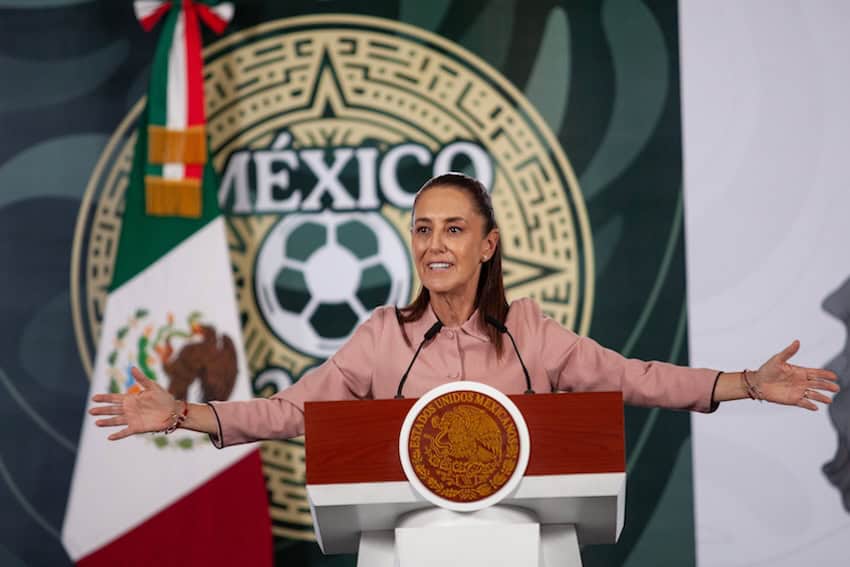
Sheinbaum’s mañanera in 60 seconds
- ⚽ The Social World Cup for ordinary citizens: As Mexico kicked off its third FIFA World Cup hosting stint Thursday, the president brought up the Social World Cup program, noting that it had received little publicity with so much other activity taking place. Through the program, some 500 tickets were distributed exclusively to ordinary citizens — not public officials.
- 🍎 A shift in strategy in dealing with striking teachers: As protesting teachers caused roads around the city to be shut down and threatened to block the Zócalo World Cup Fan Fest themselves, Sheinbaum announced that her government will bypass negotiations with the dissident CNTE union’s leadership and instead consult with over 1 million teachers directly, school by school, beginning in August.
- 🕯️ Mothers of the disappeared: Interior Minister Rosa Icela Rodríguez spoke of the previous night’s march by families of missing persons and their supporters, revealing that the government is investigating how some Jalisco participants were bused in. She stressed, however, that the families’ grievances are legitimate.
- 🤝 USMCA on the table: Sheinbaum rejected the idea of replacing the trilateral USMCA with multiple bilateral agreements, calling the pact one of U.S. President Trump’s “great achievements” from his first term and arguing that a strong North America is better placed to compete with China.
Why today’s mañanera matters
Thursday morning’s press conference was unlike any other in recent memory. With the opening ceremony of the 2026 FIFA World Cup set to take take place just a few hours later and only some 15 kilometers away, the president’s briefing was delivered in the context of a capital city distracted by World Cup fever.
Which is not to say there weren’t serious issues to discuss. For one thing, the dissident CNTE teachers’ union had spent the week staging marches near the Estadio Azteca (Mexico City Stadium) in an open attempt to disrupt smooth logistics operations.
Against that charged backdrop, Sheinbaum used the mañanera to signal a major shift in how her government plans to handle the CNTE standoff, while also defending the USMCA trade deal and addressing the government’s handling of protesters from the families of the disappeared.
The World Cup, and who gets to go
The government used Thursday’s conference to call attention to the Social World Cup, a government program dedicated to bringing the tournament’s social benefits beyond the stadiums. Officials from the Education Ministry and IMSS reported that more than 1.2 million youths participated in community work to rehabilitate 4,150 sports courts nationwide, and that 6,004 murals were painted across the country.
Some 500 World Cup tickets allocated to the federal government were distributed entirely to citizens — not a single ticket went to a government employee. Winners included students, artisans, senior soccer players and children with Down syndrome who competed in specially organized tournaments.
One standout was Estrella, a student from a SETI vocational high school in Tamaulipas and daughter of a single maquiladora worker, who won first place at a 2025 international science and technology competition in Chile and was selected to do the opening coin toss at the inaugural match, as was later seen by millions of viewers.
“We decided that no tickets would go to public officials — they all had to go to the people,” Sheinbaum said.
CNTE conflict: Going around the union
The most politically significant announcement of the morning had to do with the teachers’ union standoff, which has threatened to disrupt the World Cup festivities as union teachers stage disruptive protests in Mexico City. Education Minister Mario Delgado said the government held a fourth consecutive round of talks Wednesday with the CNTE — the National Coordination of Education Workers — over two core demands: abolition of the teacher career evaluation unit (Usicamm) and a pension overhaul. After hours of negotiations, the CNTE announced it would march near the stadium anyway.
Sheinbaum responded by announcing she would sidestep the union leadership. Starting in August, during the pre-semester week that teachers use to prepare for the new school year, the government will consult every teacher in Mexico directly — school by school.
“The teachers should decide,” she said. “Not just a union leadership, but the teachers themselves.”
“We’re going to go directly to the teachers to tell them what we are doing, without any intermediaries,” she said, but acknowledged that many teachers will still have union representation through the SNTE, a teachers union older and bigger than the CNTE.
On pensions, Sheinbaum rejected the CNTE’s call to simply repeal the 2007 ISSSTE reform ISSSTE head Mario Batres added that the government had come to every meeting with detailed proposals, while the CNTE “never presented a counterproposal.”
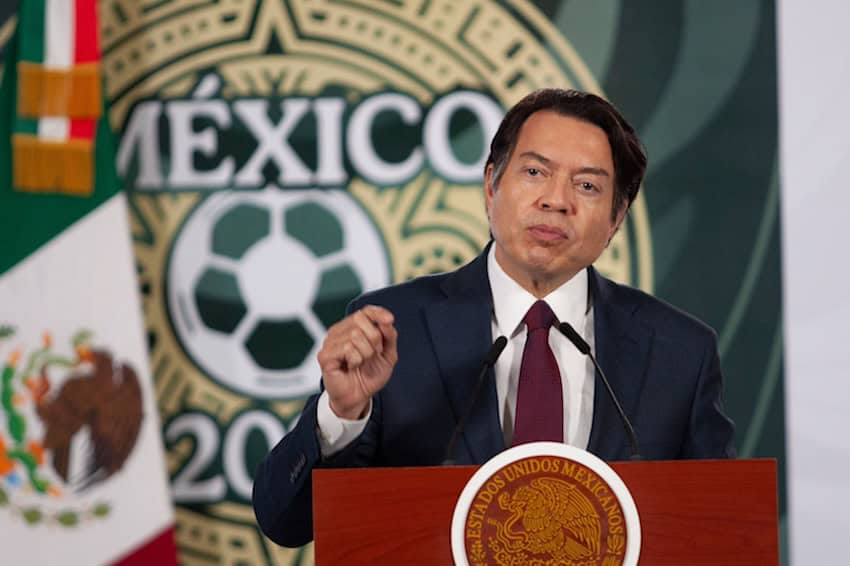
For that reason, Delgado suggested that the CNTE’s actions are not in the interests of its members. “It’s more a political interest driving them right now,” he said, referring specifically to the decision to protest near the Estadio Azteca on the day of the World Cup inauguration. “It’s an attempt to damage Mexico’s image internationally.”
Families of the disappeared march
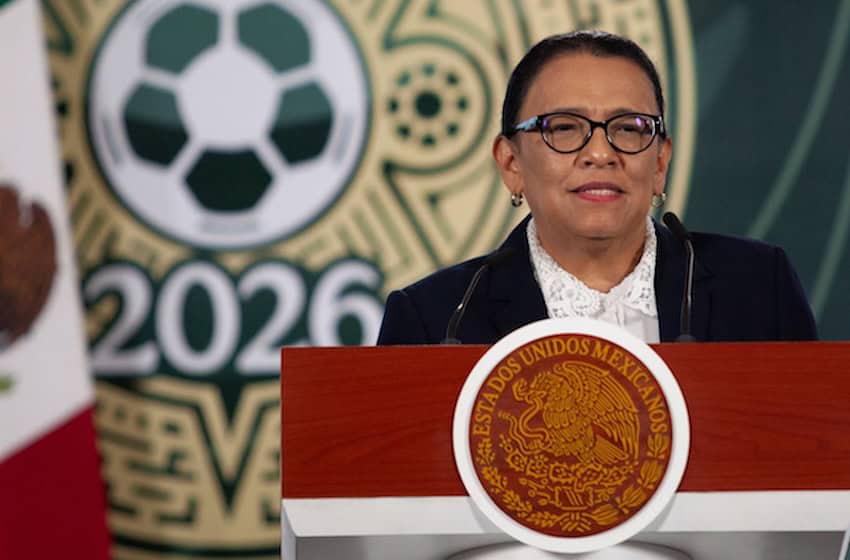
Interior Minister Rosa Icela Rodríguez came to the podium and reported on two separate protests that took place in Mexico City on Wednesday evening. A march by roughly 2,000 people commemorating the 1971 Halconazo massacre passed without incident. A second, nighttime mobilization brought together hundreds of mothers and families of disappeared persons, accompanied by search collectives.
Rodríguez said federal officials from the National Search Commission and the Executive Commission for Victim Attention were present throughout the march. She expressed solidarity with the families, but noted that some participants from Jalisco had arrived on organized buses, and said authorities were investigating who paid for the transportation.
“We have respect and solidarity for the mothers and searching families,” Rodríguez said. “[But] we are also gathering information to determine the origin of any financial support and whether there was any intention beyond the legitimate demand for justice that the families are leading.”
Sheinbaum, asked directly whether she suspected a specific political actor was financing transportation, said the government had only confirmed that people from Jalisco arrived by bus, stressing that the information was preliminary and did not delegitimize the families’ cause.
Sheinbaum on USMCA: ‘I believe the treaty will hold’
In the conference’s most geopolitically charged exchange, Sheinbaum pushed back against U.S. President Donald Trump’s recent implication that the U.S. would not renew the USMCA free trade deal. She also rejected suggestions that the trilateral agreement — known in Mexico as the T-MEC — could be replaced by separate bilateral deals.
The president argued that the treaty benefits all three countries equally, pointing to the spike in U.S. vehicle prices as evidence that tariffs on Mexico had backfired. She also reminded reporters that Trump himself negotiated the USMCA in his first term. “It is one of his great achievements,” she said.
She pointed out that Trump’s negative comments this week had been made before, choosing as an ironic example Trump’s statement that the USMCA is better than NAFTA was. “That’s something we agree with,” she said.
Her conclusion? “We believe the USMCA will hold,” she said flatly.
Portions of this story were drafted with assistance from Claude. The article has been revised and fact-checked by a Mexico News Daily staff editor.
