


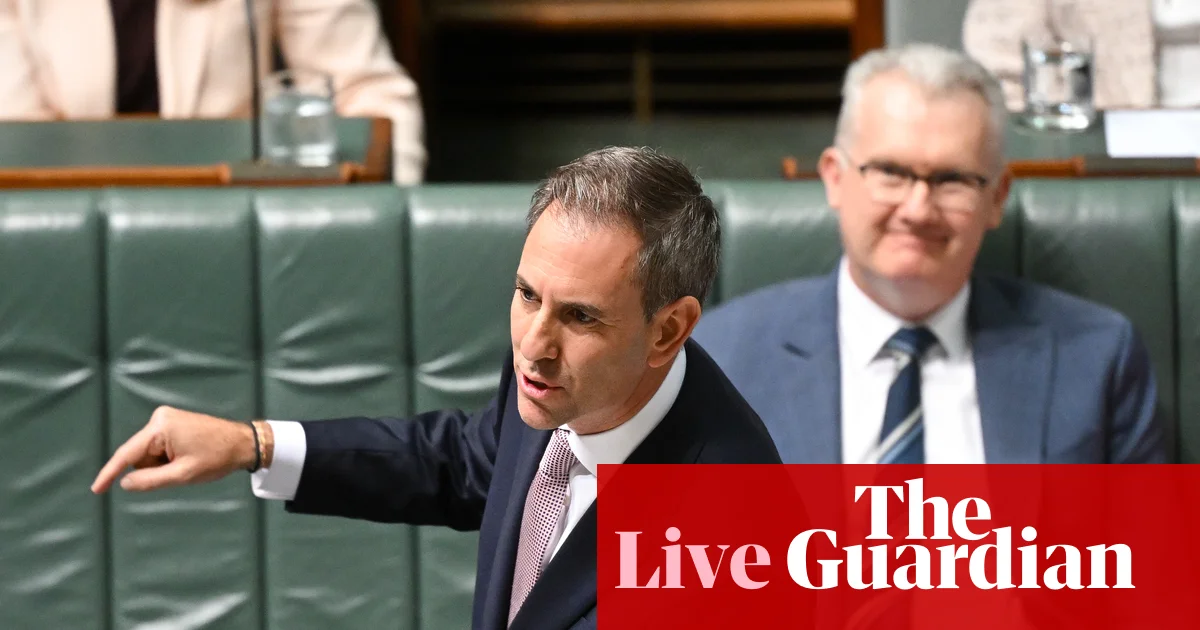
Wilson ‘not the sharpest tool in the shed’, says Chalmers
It feels like it’s been a while since Jim Chalmers has been asked a question by the opposition – most have been aimed at the PM, but it’s the treasurer’s time back in the spotlight.
The shadow treasurer, Tim Wilson, asks Chalmers if he’ll confirm that the government has claimed $410 of extra tax from the average worker through bracket creep in the last 12 months and that the working Australians tax offset “will be chewed up by bracket creep within a year?”
Chalmers gets personal immediately:
Mr Speaker, if anybody is looking for evidence the member for Goldstein is not the sharpest tool in the shed, how about him asking about tax cuts on a day that their party room decided to vote against tax cuts for 13 million Australian workers?
Wilson gets up to make a point of order, but Labor MP Luke Gosling makes a remark, which gets him kicked out of the chamber by Milton Dick.
Wilson says he knows Chalmers “enjoys throwing abuse”, but argues he’s not answering the question. Dick tells Chalmers to stop talking about opposition policies.
Chalmers continues:
Now, when it comes to returning bracket creep, this is a government which has returned bracket creep on five occasions, using three different mechanisms … If they had their way, Australians would pay higher income taxes not lower.
Key events
Nationals ask for clarity on ‘new build’ under housing changes
Nationals MP, Michelle Landry, says that the government’s bills do not define what a new build is, so asks: “if someone builds a new second dwelling on an existing title, is the whole title now considered a new dwelling?”
I.e, if someone has a single dwelling and builds a duplex on the land, do they qualify for the tax concessions?
The housing minister, Clare O’Neil, gives a very short response, and doesn’t provide much clarity.
The answer in its entirety:
A new dwelling is one that genuinely adds new to housing supply.
Liberal MP Zoe McKenzie gets a go next and asks Jim Chalmers if he will confirm that the government’s tax bill will “grant him extraordinary powers to slash the $250 tax offset to zero whenever he likes without taking it back to the parliament?”
This morning Chalmers was asked a similar question on morning media, and said that the assertion that he has “god-like powers” under the legislation was a “beat-up”.
Chalmers again has a jab at Tim Wilson, and says “Mr Speaker, I would haven’t given another question to Goldstein either.”
The truth is, the fact is that it’s not unusual for tax laws to work this way or for definitions to be finalised by legislative instrument. They can be disallowed by the parliament.
McKenzie stands up to make a point of order on relevance:
I think what the treasurer is trying to say is “yes”.
Milton Dick calls that an “abuse” of standing orders and gives her a warning. Chalmers continues:
Those opposite want to pretend that these are unusual arrangements. They are not.
The reason they want to pretend is because they can’t defend their actual position which is to go to the wall for a broken status quo that particularly locks too many young Australians out of the housing market.
Wilson ‘not the sharpest tool in the shed’, says Chalmers
It feels like it’s been a while since Jim Chalmers has been asked a question by the opposition – most have been aimed at the PM, but it’s the treasurer’s time back in the spotlight.
The shadow treasurer, Tim Wilson, asks Chalmers if he’ll confirm that the government has claimed $410 of extra tax from the average worker through bracket creep in the last 12 months and that the working Australians tax offset “will be chewed up by bracket creep within a year?”
Chalmers gets personal immediately:
Mr Speaker, if anybody is looking for evidence the member for Goldstein is not the sharpest tool in the shed, how about him asking about tax cuts on a day that their party room decided to vote against tax cuts for 13 million Australian workers?
Wilson gets up to make a point of order, but Labor MP Luke Gosling makes a remark, which gets him kicked out of the chamber by Milton Dick.
Wilson says he knows Chalmers “enjoys throwing abuse”, but argues he’s not answering the question. Dick tells Chalmers to stop talking about opposition policies.
Chalmers continues:
Now, when it comes to returning bracket creep, this is a government which has returned bracket creep on five occasions, using three different mechanisms … If they had their way, Australians would pay higher income taxes not lower.
Government says draft environmental standards to be released in ‘coming weeks’ for consultation
When will the remaining national environmental standards under the environment protection and biodiversity conservation (EPBC) Act be released to the public, asks independent MP Helen Haines.
She says the environment minister agreed to community engagement on the standards as part of reforms, but it’s been six months and “we’ve only seen drafts of two of the five standards.”
Tony Burke (representing the environment minister, Murray Watt) says the standards in question are “supplementary guidelines to get the system up and running”.
He says consultation on the first standard has just closed, while the second is open and closes soon. The remaining are coming soon, Burke says:
The standard raised in the question is, as well as these standards being out for consultation, community consultation itself will have a standard, and I’m advised that work on that is well progressed to this standard and the government anticipated it will be released for its consultation in coming weeks.
Taylor tests PM on budget tax take
Angus Taylor is back and asks the same question, “will the prime minister confirm that Australian also pay $77bn more tax than they get back?”
It’s a bit tighter this time, so Taylor is hoping for a more direct answer.
The $77bn dollar figure one of the estimates of how much more the government could earn from the tax reforms including negative gearing and CGT over a decade.
Anthony Albanese shakes his head as he comes up to the despatch box and says the question “didn’t really make sense”.
They oppose income tax cuts, and the other thing that they oppose is the real wage increases … consistently we [have] made submissions to the Fair Work Commission arguing for increases in real wages, something those opposite have never, ever, ever done.
Taylor tries to make a point of order on relevance, but leader of the house, Tony Burke, counters saying that because the question ended with “and what they get back” (which isn’t 100% accurate), “then the full relationship is able to be answered and is relevant”. That’s the rules for you!
The PM then goes back to the wedge that the opposition doesn’t support income tax cuts (because the Coalition will be voting against the whole tax package).
We on this side of the House stand for working Australians. We stand wages, lower income taxes, and for people to earn more and keep more of what they earn.
Question time begins as Andrew Wallace first MP to be booted
Angus Taylor begins by asking the prime minister if he will confirm Australians will “pay $77bn more tax than they get back”, after the Treasury secretary Jenny Wilkinson last week said on the changes to the CGT and negative gearing: “Revenue needs to be raised from somewhere”.
Milton Dick immediately tells the opposition to pipe down, saying, “We don’t need the “wows””.
Anthony Albanese begins his answer saying that he can confirm that “Labor is the party of aspiration”, which naturally gets a chorus of groans and shouts from the Coalition.
It rebalances the ledger, so that young people have an opportunity [to buy their first home] and we saw that just on the weekend.
The opposition tries to make a point of order but they don’t get very far. Then the PM comes back swinging, taking aim at Tony Abbott’s appointment as the Liberal party national president:
He [Abbott] did seven interviews yesterday because he knows that this bloke just ain’t up to the job.
At the end of the answer, Liberal MP Andrew Wallace gets booted for interjecting 10 times.
Cait Kelly
Advocate says mutual obligations system shows ‘punishment is being prioritised over accountability and the law’
Earlier, we reported from Senate estimates that the Targeted Compliance Framework, the IT system that runs Australia’s controversial mutual obligations regime, will be offline until 2027.
The automated IT system was illegally cancelling people’s payments.
Welfare advocate at the Antipoverty Centre Jeremy Poxon has responded, saying it “was madness” to announce the return of the TCF and payment cancellations, when the department “can’t even answer basic questions about the legality of the scheme”:
At every turn, the Department has failed to demonstrate to stakeholders or the general public how the TCF can be brought into lawful operation.
In fact, the department doesn’t even know how many people have been impacted by unlawful TCF decisions, as evidenced by the latest budget papers listing compensation for TCF victims as “unquantifiable”. Speed-running cancellations back into operation once again shows that punishment is being prioritised over accountability and the law.
Despite the Ombudsman’s ongoing concerns about high numbers of incorrect payment suspensions, these punishments from job providers have continued. To date, the Department is yet to provide any evidence that they’re lawful.
In pics: parliament today
As we near the downhill slide towards question time, let’s take a look at what has been going on around parliament today.

Melissa Davey
Only 40% of aged care support at home algorithm decisions found to be appropriate
Of the aged care support at home funding decisions that have been reviewed by the department of health and ageing for review between November and March, more have been changed or approved for reassessment than have been confirmed as correct, Senate estimates has heard.
Under questioning by Greens Senator Penny Allman-Payne, department of health and ageing officials said 92 decisions made by the support at home assessment algorithm had been deemed upon review as appropriate, while 132 had been varied or set aside, which means the person can get their support at home assessment redone.
Meanwhile 215 people had withdrawn their application for a review, while 102 review applications were deemed by the department as having no legal standing, estimates heard.
Read more:
Taylor tries to thwart debate on CGT bill
There are some political shenanigans going on in the house today over the government’s budget bill – which includes changes to the capital gains tax discount, negative gearing, the working Australian tax offset and standard tax deductions.
The opposition leader, Angus Taylor, who has said the party will vote against the bill, tries to put some roadblocks on the legislation being debated (which would delay it being passed). He also calls on the government to pass laws to index personal income tax brackets to end bracket creep (a policy he announced in his budget reply).
In response, the leader of the house, Tony Burke, moves to suspend standing orders to essentially bulldoze that roadblock, and ensure that it’s passed tonight. The government has the numbers so it’s not hard to predict which way the vote will go.
Earlier on, Taylor addressed the house attacking the government’s bill:
The government’s CGT changes will shut down growth enabling investment, they will obliterate opportunity. And they will kneecap so many Australians. It’s no wonder that we see Australians expressing their frustration.
Some are doing it in satirical ways. And every day there’s new AI memes, depicting the prime minister as a business co-owner, a co-founder who never puts his shoulder to the wheel.
‘We are not going to get the deal that was promised to us’: Husic calls for a rethink on Aukus
Labor MP Ed Husic says Australia will not get the Aukus deal promised by the US, and says the government should rethink the pact.
Guardian Australia understands Husic was the MP who raised concerns about the deal in Labor’s party room meeting earlier this morning.
Speaking to Sky News, Husic says he won’t go into what was said in that meeting, but voices several concerns over the agreement.
He says that the deal today is different to what the Morrison government promised when initially signing alongside then US-president Joe Biden and the UK, and adds “you can see how the Trump administration behaves, it should be rethought”.
We need to be open as a nation that we are not going to get the deal that was promised to us … and given how transactional the Trump administration is, you can almost imagine them saying we give you these, you will do this with them, and so there’s an active sovereignty question there.
