


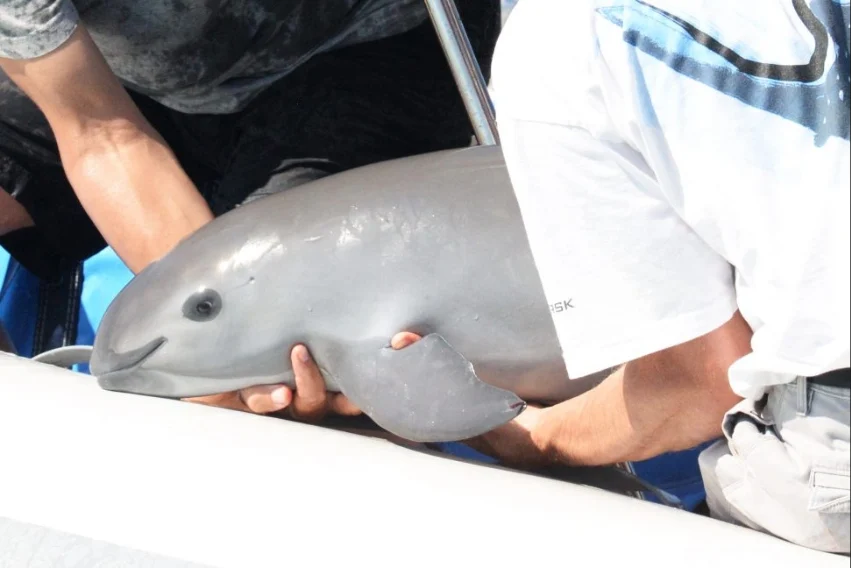
Mexico has reduced the zone where gillnets are banned by 86%, saying the smaller area will ease restrictions on fishermen while focusing conservation efforts on protecting the nearly extinct vaquita.
The new rules, which went into effect Thursday, shrink the restricted area in the Upper Gulf of California from 11,106 square kilometers (roughly the size of Jamaica) to 1,562 square kilometers (slightly larger than Mexico City).
Last year, scientists estimated that just seven to 10 vaquitas remained in the Upper Gulf of California — the species’ only habitat across the globe. The vaquita is the world’s smallest porpoise.
President Claudia Sheinbaum praised the change as a way to protect biodiversity while supporting fishing communities whose livelihoods have been constrained by the restrictions.
The Environment and Natural Resources Ministry (Semarnat) said the boundaries follow recommendations from the International Committee for the Recovery of the Vaquita, based on sightings and monitoring over the past two decades — such as a 2019 count showing 22 remaining vaquitas.
The population collapse from about 600 in 1997 has been driven by vaquitas becoming entangled and drowning in gillnets, large mesh nets that are often set illegally for totoaba, a fish whose swim bladder is prized in China.
Within the newly revised zone, fishermen may use only approved gear — no gillnets.

Within the larger area, a 225-square-kilometer Zero Tolerance Zone will retain its boundaries and total ban on fishing, but the new decree authorizes a transit channel for qualifying, small fishing boats. Gillnet fishing remains prohibited along that route.
The agreement also requires boat monitoring systems and identification markings for gillnets used outside the prohibition zone.
Lorenzo Rojas-Bracho, a marine biologist and senior adviser at the San Diego–based National Marine Mammal Foundation, said that concentrating enforcement could help save the species.
“It is difficult to enforce a ban over a very large area, which includes vast areas with no recent records of vaquitas,” he told Reuters. “If you lose a ring, you don’t search your entire house. You focus on where you lost it.”
However, another scientist, biologist Gerardo Ceballos of the National Autonomous University of Mexico (UNAM), told Reuters that authorities lacked the technical and logistical capacity to enforce even the smaller zone.
The changes come after a July meeting in which UNESCO gave Mexico six months — until Feb. 1, 2027 — to report on concrete steps to protect its Gulf of California World Heritage site, including the vaquita, and address threats from proposed liquefied natural gas (LNG) projects.
However, the new decree does not cite UNESCO as its impetus.
It explicitly links the revisions to Mexico’s commitments under CITES, an international treaty intended to ensure wildlife trade does not threaten species’ survival. The document cites a Feb. 5 decision for Mexico to pursue the revisions, before UNESCO’s July meeting.
Adult vaquitas grow to roughly 1.5 meters (5 feet) and weigh about 30 to 55 kilograms (65 to 120 pounds).
A training expedition in May recorded sightings and acoustic detections; however, the next full observation survey isn’t planned until May 2027.
With reports from Reuters, Reforma and SDP Noticias
