


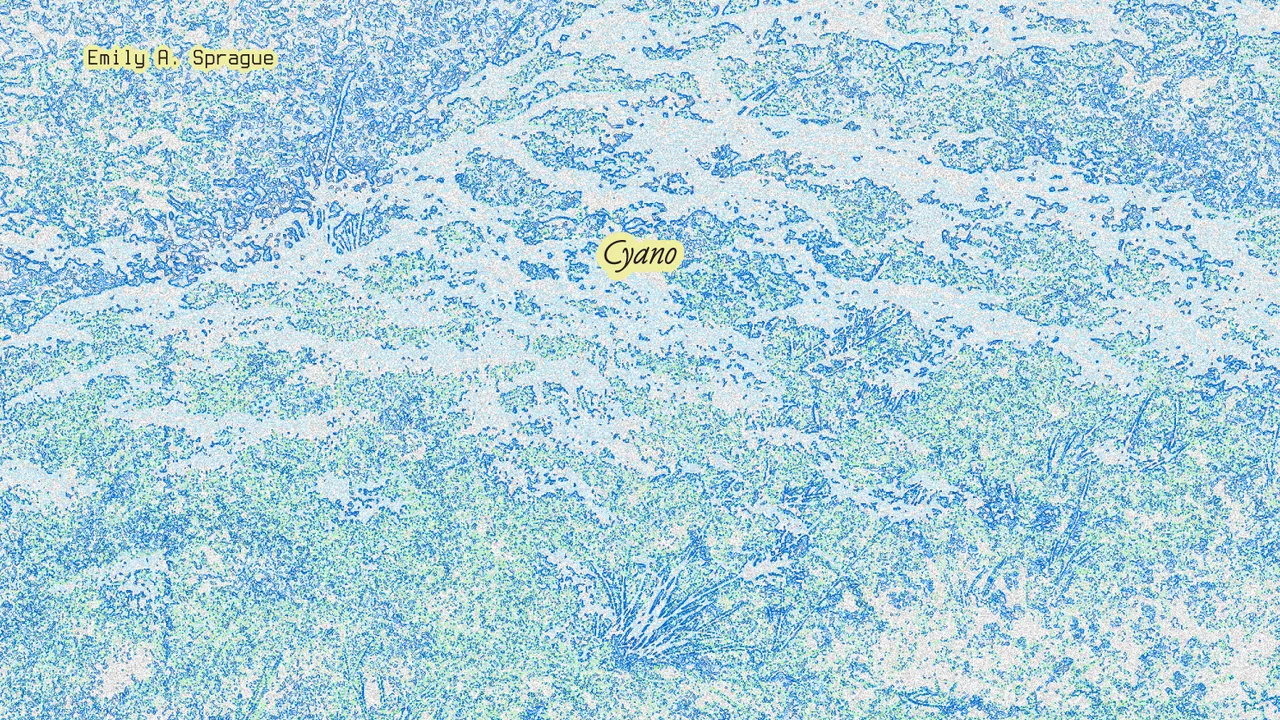
Anna Atkins, the 19th century botanist and photographer whose Photographs of British Algae: Cyanotype Impressions is widely regarded as the first photographic book, made her images by placing algae directly onto paper coated with a light-sensitive solution. Where the plant blocked the ultraviolet light, the paper remained white. Everywhere else, it turned the deep Prussian blue that gives the process its name. At the center of each image, the algae’s fronds produced their own negative.
Emily A. Sprague first encountered cyanotypes while shooting film photography in her bathtub around 2018, when she was experimenting with leaking light into film and altering development times and temperatures. As opposed to her role as a singer-songwriter in the band Florist, Sprague has always approached her ambient solo recordings “more like photography,” a way of capturing a place and a specific moment in Sprague’s life. She has never recorded in the same location twice.
No score yet, be the first to add.
On Cyano, her latest modular synth-driven ambient album, Sprague is trying to document something that cannot really be captured, like a smell or a dream. Rather than preserving a particular moment or telling a linear story, she uses fragments of lyrics, field-like electronic textures, and recurring images to give form to sensations that are difficult to describe. The lyrics often take the perspective of an observer moving through the natural world and trying to understand how she interrelates with it—a figure partly inspired by Atkins.
There is also something newly scientific about Sprague’s own process. She brings the intuitive, associative way she has traditionally written that has animated both her solo music and Florist into a more deliberate, rigorous practice. Her music tends toward slow pacing and stasis: a kind of minimalism that foregrounds the frenzied activity concealed inside something that appears still. That might mean holding a note or asynchronous loop for an unusually long time, while she plugs in some barely perceptible harmonies and whizzing overtones. It is like watching bacteria swim beneath a microscope.
