


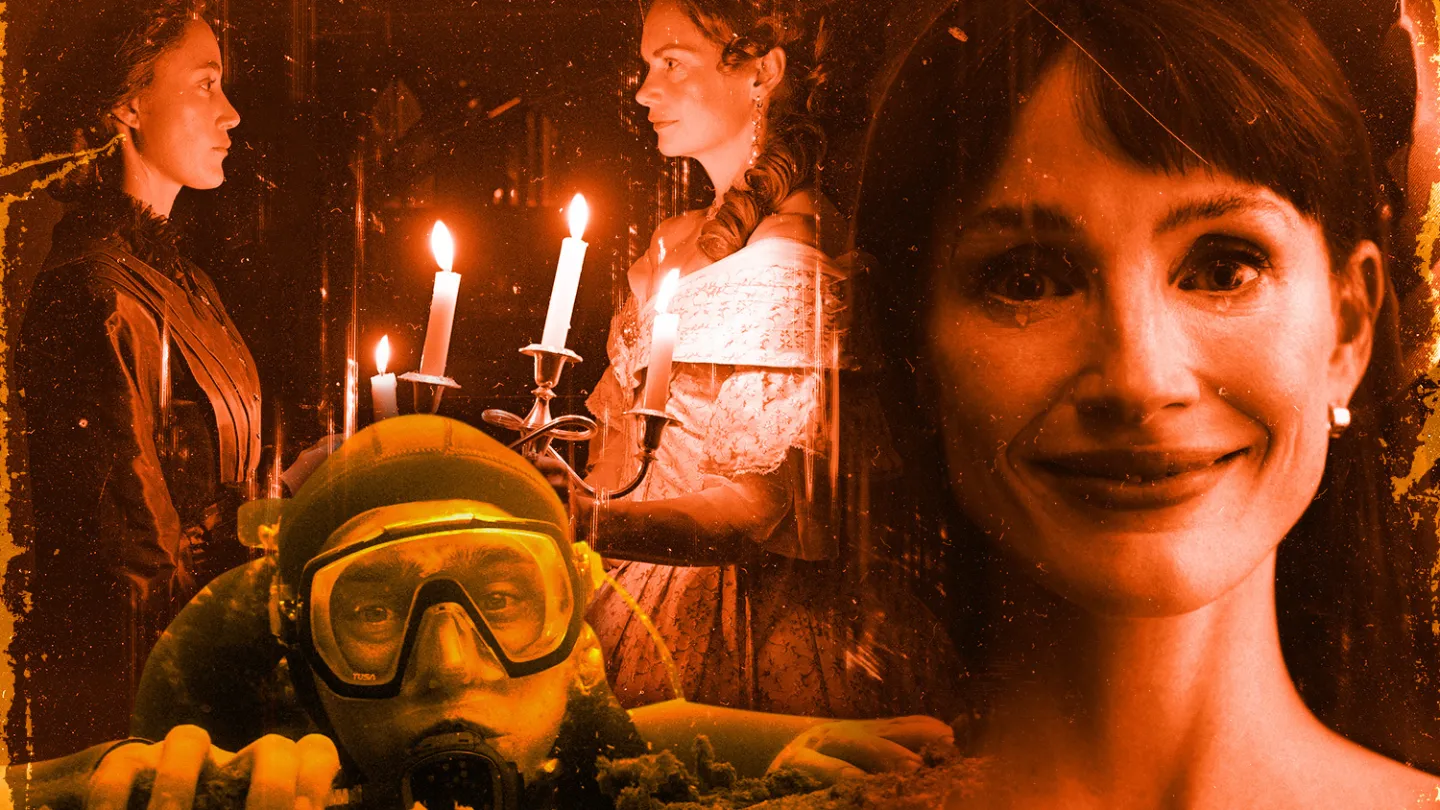
Some stories refuse to stay on the page. The Hollywood Reporter’s Beyond the Book column explores what happens when books make the leap to screen and beyond — unpacking what stayed, changed, how it was done and why it matters with the creatives who made it.
***
Horror fans are about to have a very frightening season, and three novelists are largely to blame.
In their books, authors Josh Malerman, Virginia Feito and Daniel Kraus dreamt up unique nightmares that could keep readers up at night: a supernatural presence invading a family’s home, a diver trapped inside a whale with an hour of oxygen left, and a Victorian governess with a murderous agenda — and dark sense of humor. But now those stories are now making the leap from page to the big screen in the film adaptations Other Mommy (out Oct. 9), Whalefall (Oct. 16) and Victorian Psycho (out Nov. 13).
Each of the adaptations offers a spectrum of how horror is explored: The Other Mommy delves into intimate psychological horror, Victorian Psycho blends gothic horror with dark comedy, and Whalefall presents a survival thriller infused with intense body horror and visceral, claustrophobic elements.
The books themselves arrived in quick succession, with Kraus’ Whalefall in 2023, Malerman’s Incidents Around the House (renamed Other Mommy for the film) in 2024 and Feito’s Victorian Psycho in 2025. It’s only fitting that their film versions are now following one after another.
But prior to their release dates, each has already made noise. Universal’s Other Mommy trailer became the talk of The Odyssey screenings. Victorian Psycho survived casting shake-ups and a studio exit all to later land a Cannes premiere. And a six-minute Whalefall sequence was a hit of CinemaCon.
Also notable is each has unique premises that on paper could be considered difficult to adapt. But, Feito notes, the stories are “all reminiscent of something” and you “can’t quite put your finger on whether you’ve seen anything like them in a movie before.”
“They combine different inspirations or references, or they feel purely original, and I think that’s refreshing for Hollywood,” she tells The Hollywood Reporter.
Victorian Psycho marks Feito’s first adaptation, one for which she wrote the script herself. The Zachary Wigon-directed film stars Maika Monroe as the dark Victorian governess. Meanwhile, Malerman and Kraus are seeing their works come to life onscreen again. Malerman’s Bird Box was released on Netflix in 2018 and starred Sandra Bullock. Now his book Incidents Around the House is getting the adaptation treatment in Other Mommy with Jessica Chastain as the frightening mother at the center of the haunting directed by Rob Savage and the author executive producing. With Guillermo del Toro, Kraus co-authored The Shape of Water, based on the same idea the two created for the Oscar-winning film, and co-authored Trollhunters, which was adapted into the Emmy-winning Netflix series. Now he co-wrote the screenplay for the adaptation of Whalefall, directed by Brian Duffield and starring Austin Abrams and Josh Brolin.
Despite having gone through the adaptation process before, Malerman and Kraus say they stay grounded in the writing itself.
“If I’m thinking about a potential movie adaptation while I’m writing a novel, that is the day that novel’s dead,” Kraus tells THR. “If anything, I stray the other way: what can I write that’s unadaptable?”
“I wrote like 14 books before Bird Box got published, and I’ve maintained the exact same spirit the entire way through,” Malerman says. “I say to myself, ‘You weren’t worried about any list or movie adaptation or likes or views before. Don’t worry about that now.’ I believe this office is a safe place, meaning I’m not changing what I do for the sake of some perceived success.”
Over a lively roundtable discussion with THR in August, the authors discussed the upcoming adaptations of their books, their starry casts, the varied horrors they offer through their premises and divulge their fears while debating whose protagonist has it worst (hint: there’s still Geppetto trauma.)
Whalefall, Incidents Around the House and Victorian Psycho.
Atria Books; Del Rey; W.W. Norton & Company
To start with an icebreaker: Between a supernatural threat invading a family’s home, a Victorian governess with a very dark secret and a murderous plan, and a teenager being swallowed by a whale, you’ve dreamed up some pretty terrible days for your protagonists. Who do you think is having the absolute worst day?
VIRGINIA FEITO I’m very afraid of the ocean, so honestly, a whale is the scariest option for me. I’m terrified of the ocean.
JOSH MALERMAN I’m with Virginia. My wife, Allison, and I went to Spain recently, to Mallorca. I’m not really a beach guy. Anyway, we went in the water, and Allison got stung by a jellyfish! So I’m going with Whalefall.
FEITO That’s why I don’t go to Mallorca. There are always jellyfish there. It’s insane. The water is just too warm.
Daniel, do you feel obligated to say yours?
DANIEL KRAUS Obligated, but it’s true. It’s the worst day one could possibly dream of. A terrible way to go.
On paper, your stories might each be hard to make for their own reasons. What do you think made Hollywood bet that a premise built for the page was worth making the jump to the screen?
MALERMAN That’s a hard question, because from my angle, any number of books could work. But I do think all three of these are streamlined. I don’t want to say simple ideas, but streamlined, and not just in setting, although Daniel’s is mostly one setting and Incidents Around the House is mostly one setting. Virginia, I read your book last night and I have so much to say. I’ll write to you later.
FEITO Absolutely, please do! Thank you!
MALERMAN And yours is mostly one setting as well. So there’s a streamlined nature, but I’d hope it has more to do with the thinking behind it.
FEITO I think they’re all reminiscent of something, but you can’t quite put your finger on whether you’ve seen anything like them in a movie before. They combine different inspirations or references, or they feel purely original, and I think that’s refreshing for Hollywood. With Other Mommy, I kept thinking of Coraline. It’s not a spinoff of Coraline, but you can’t quite define it either.
KRAUS I was shocked that anyone would consider making a movie of Whalefall. It seems relatively unfilmable, so I was surprised anyone would be interested, much less several parties. All I can say is that the one-line premise is so powerful. In some ways it’s the oldest story ever, one of the oldest man-versus-animal stories in history, older than biblical. There’s a primitive part of our brains that still fears being eaten by something bigger than us. Maybe that’s what grabs us in the cerebral cortex.
MALERMAN It’s not even primitive. It’s right there in the foreground.
FEITO Yeah I was going to say, I’m still traumatized by Geppetto eaten by the whale in Pinocchio, which is one of the most disturbing films I’ve ever seen.
MALERMAN Yeah, we can’t get out, we just have to live here.
FEITO It’s Geppetto’s trauma all over again!
Each of you had a hand in your adaptation: Josh as an executive producer, Virginia and Daniel as screenwriters. Can you talk about deciding your level of involvement, and the trade-off between wanting creative control and needing to let a director make the story their own?
KRAUS This one was a little different. It’s an extremely personal book, with autobiographical parts, though not the whale parts, obviously. In addition to co-writing it, it made sense to everyone to keep me involved more heavily than most writers are. For a long period into pre-production, I knew the most about whales. Through the early designs of the stomachs and the writing of the script, I just knew the most about whales: what things should generally look and feel like. So I was always involved in the production, if for no other reason than that.
FEITO I’m very grateful that Zach [Wigon], the director, thought I could write the script. I didn’t think I could. I didn’t know where to go with it, so a great director basically directed the script. There was none of me fighting for creative control at all. I was just like, please let the other talented people on this team make all these decisions.
I kept telling myself, I don’t want to write the book again. I wrote it by myself, I’m happy with it, I edited it, it’s published, and I’m out. I’d love to learn this new language, the language of the screen, and translate the story into it. I love adaptations of all kinds. Rosemary’s Baby is almost the same text as the book, but I also love The Shining, which is not, and I think Stephen King wasn’t very happy with it as the author of it. I don’t think there’s any right way to go about it. Just do whatever makes you feel better. In my case, I wasn’t precious with any of it.
And logistically, there was no budget for stables. We couldn’t film in Christmas even though it’s set then. Maika [Monroe] was only available that summer, so we had to shoot in the summer. You just have to be realistic.
MALERMAN I’ve been in a band with my best friends for about 30 years. We met when we were 11. There are two songwriters in the band, me and Mark, so I’m used to writing a song, bringing it to the boys, and letting them do what they do. We were broke and living on the road for about seven years, touring without apartments. I was writing novels the whole time, and that’s when I understood my artistic experience: I write the song, and they make the music.
With Bird Box and Incidents Around the House, it’s the same feeling. To me, Incidents is a few notes on the piano, and the movie is a great electric version of it. Some songs don’t go the way you wanted, and other times they’re better than you wanted, and you think, “You guys made this song I wrote better than I did.” So I’m 100 percent at ease with it. We weighed in here and there, but there was also a sense of, “No, Josh, you wrote Bird Box. Let Sandra Bullock and company make the music. You wrote Incidents Around the House. Let Rob Savage and Jessica Chastain play this song.”
Josh, this is your second major adaptation since Bird Box. What did you know this time about the adaptation journey that you didn’t know then?
MALERMAN We were definitely more involved on the producer side. Bird Box was optioned before the book even came out, and it was my first book, so I had no leverage. They were super warm, though. I went on set, met the producers, went to the premieres. I was so scared to meet everyone, I was trembling.
This time I was on the whole email chain and kept abreast of every step. They asked for our notes. We went to Dublin and were on set for four or five days: me, my manager, and Allison, my wife. So there was a difference in that way, but not a real difference in my involvement in how it went, or in the script.

Jessica Chastain as Other Mommy in Other Mommy, directed by Rob Savage.
Universal Pictures
Rob Savage directed. What made him the right director for this story?
MALERMAN For me, the dream is finding your book in the hands of an artist. It felt that way on set and in the meetings, but it wasn’t until Allison and I saw the movie. I’d prepared myself: “If it’s not very good, who cares? Let’s drink.” But then I got more scared when I asked myself, “What if it’s good?” Three minutes in, I turned to Allison and said, “This is good. We’re in the hands of an artist.” Rob has his own vision, his own pace, his own style. He does a lot of directing without talking. He’ll pantomime what to do. It was very cool.
FEITO Yeah the same for me! It [the film] might be shit, but at least I’ll have a shit movie instead of no movie at all. What do you bitches have? (Laughs.) My imaginary detractors didn’t exist yet.
Daniel, you’ve worked closely with Guillermo del Toro before, who is known to be a horror maestro and explores monsters. How did that influence show up, or deliberately not show up, in your collaboration with Brian Duffield on Whalefall?
KRAUS I don’t think it shows up at all. It’s completely different. I’ve done a number of collaborations over the years and they bear no resemblance to one another. I’m sure there’s some accumulation of lessons from the people you work with, but it’s hard to sift out what carries over. As someone who continually changes genres, I don’t specifically want to carry over influences. I want to reinvent each time. Whether I’m collaborating, reading a book, or watching a movie, I want it to be as dramatically different from the previous experience as possible.
FEITO But does that drive you creatively? Do you find yourself changing direction based solely on being fresh and original?
KRAUS Yes, that’s really the only thing that guides me to the next project: that it’s as radically different from the previous one as possible, in genre, style, point of view, long chapters versus short chapters. I want to be as radically different as I can, and to make establishing a fan base as horrifically difficult as possible (Laughs.)
FEITO That’s fascinating. It is the opposite of what writers usually do.
The concept of Whalefall may seem far-fetched, but the science behind the premise was very well researched. How much research went into making the survival elements feel scientifically grounded?
KRAUS Anyone who says this couldn’t happen just hasn’t spoken to as many scientists as I have. Everything in the book is possible. I always do a lot of research, but this was different because there weren’t really any materials on it. I had to front-load the writing of the book with a few months of talking to scientists and divers, people who dissect whales for a living, just to even figure out what the plot could be. I had no interest in doing it abstractly or metaphorically. I was only interested if I could do everything scientifically. So the plot came from talking to all these scientists and biologists and asking: How big is it? How hot is it? What does it smell like? What happens if you touch this? Can you go over here? Can you go over there? The plot is built from the realities of what’s possible.
Austin Abrams as Jay Gardiner in 20th Century Studios’ Whalefall.
20th Century Studios
Virginia, you said you didn’t want to write the book again. As a screenwriter, how did you want to evolve the story for the screen?
FEITO I think I left that problem to the others. I accepted Zach’s guidance. The reason I wanted him to direct, apart from loving his previous movie Sanctuary, and thinking he’s genuinely talented, is because he had such a clear vision of where to take it. Sometimes it was logistical: we had to cut something because we didn’t have money for horses. Other times Zach wanted to delve deeper into certain aspects, though I think he kept the spirit we’d discussed early on. For instance, we didn’t want do flashbacks. In the novel we go back to her childhood and explore how she became the person she is, but in the movie we wanted to focus on the present and make it as present as possible.
MALERMAN Can I ask you something? I read it last night, and some of those flashback scenes are unbelievable. Is there still a mention of them? You don’t have to spoil anything.
FEITO The one with the crow and stuff? No, there’s not really any mention of her childhood, which I love as a viewer. I love that we don’t know what Patrick Bateman’s childhood was like, even though we can take a guess. I love that Maika’s Winifred is a bit more mysterious than the book Winifred. There isn’t even a teasing reference to all the stuff she did. Her reverend stepfather gets a throwaway line, and that’s pretty much it.
MALERMAN I love that, when a story just hits the ground running. I don’t care about mythology or rules or backstory. Let’s just get there.
FEITO Yeah, let’s experience it.
MALERMAN I have a note on the wall above my closet about Incidents Around the House: don’t waste any time with the parents wondering if this is real or not. Two pages at most. Immediately everyone believes her. Otherwise half the novel would be “Oh, Bela, your imaginary friends.” No, let’s get it over with. No backstory, and the movie doesn’t have any either.
So all three of your adaptations have grasped quite the attention before even coming out. Josh, much of the social media conversation around people seeing The Odyssey in theaters was about the frightening Other Mommy trailer playing ahead of it. Were you aware of that reaction?
MALERMAN Absolutely. What a brilliant idea on Universal’s part. I never would have thought of pairing those. Allison and I went to see it, and because Bird Box was on Netflix, I’d never seen a preview of one of my movies in a theater. I was rooted to my seat. I think Allison took a photo of me. When it was over, I wanted to leap up and say, “I wrote that book!” but I couldn’t even move. It was so good. Allison talked about The Odyssey for an hour afterward before I said, “Hey, also, the preview.” (Laughter.)
FEITO We didn’t get the trailer in Spain. I always feel left out, but I watched it online and it looked amazing. It went viral.
Virginia, Victorian Psycho premiered at Cannes. The project evolved from an A24 version into a new package distributed by Bleecker Street. Given the changes along the way, was there ever a fear the film wouldn’t happen at all then fast forward and it’s getting a Cannes premiere?
FEITO Absolutely. We were relatively close to shooting when we lost our Winifred with Margaret Qualley. When Ridley Scott calls, I’d drop everything too, to be frank. We were scrambling to find a new Winifred, a good Winifred. She carries the movie. The people who were already on set had to go home, and there was a real question of whether we’d be able to shoot at all. Then A24 dropped out, and we thought, well, that’s it. I’d bought all this A24 merch, which I guess I’ll have to burn. (Laughs.) I still love A24 forever.
I was definitely afraid. And just as Josh was surprised by the Odyssey pairing, I never would have imagined Cannes. I wouldn’t have thought Cannes would welcome a genre movie. It felt very validating. It’s an obviously sophisticated, elegant festival.
Maika Monroe in Victorian Psycho.
Cannes Film Festival
Daniel, a six-minute sequence from Whalefall was shown at CinemaCon and became buzzy and a big surprise of the event. In a THR interview, Brian Duffield said, “I loved that no one knew we existed. When the movies-to-look-forward-to lists came out [ahead of 2026], we were not on them, and I just liked lurking in the shadowy depths.“ Why do you think it went under the radar, and what do you make of the response to the preview?
KRAUS It’s hard for me to say. To be completely honest, all of this is out of my view. I don’t watch trailers and stuff like that, so I have no sense of what’s being talked about, not talked about. But I’ve heard a lot of people mention the trailer, and I think it works. It’s very visceral, strange, and upsetting. I think it’s smart how they’re rolling it out, because these are trailers with virtually no words. It’s just elemental force. I don’t think that’s unsavvy, because the movie itself will be a nice surprise. It’s tremendously moving, a powerful, inspiring movie, which will be a nice surprise for people who have only seen that incredible image of the diver being swallowed.
MALERMAN All I need from Whalefall is that preview, the guy swimming into the whale. I don’t even need the backstory. It’s not that I’m scenario-driven. It’s exciting, refreshing, different. I can tell from the trailer Whalefall it’s going to be an emotional ride. I think all three trailers were done very well, in that they don’t give us the whole movie.
Each adaptation has a starry cast: Jessica Chastain for Other Mommy, Maika Monroe for Victorian Psycho, and Austin Abrams and Josh Brolin for Whalefall. What did each actor bring to your protagonists, and how did they evolve from your initial vision?
KRAUS Austin, I didn’t know much about going in. He’s a real actor who’s going to be around a long time and who’s interested in going all the way. The only danger is that he’s so committed I just hope he doesn’t hurt himself (Laughs.) He’d want to do all his own stunts and just live in the role.The main shooting of Whalefall has ocean work and tanks and bigger things, but most of it takes place in a tiny stomach about the size of a tent. Whenever I peered in at Austin, who’s essentially alone in there day after day, week after week, he always seemed kind of happy. You had no choice. It was hard to get in and out, so once you were in there, you just stayed in the muck and slime. I got the sense that he was an actor’s actor, and in a weird way happy to be in there, because it was a sort of suffering.
FEITO I remember watching Weapons and thinking Austin is going to be a very important actor of his generation. I was blown away.
From left: Austin Abrams as Jay Gardiner and Josh Brolin as Mitt Gardiner in 20th Century Studios’ Whalefall
20th Century Studios
KRAUS And Josh Brolin brings so much to the role. He’s exactly who I wanted and pictured. Both Austin and Brolin, but particularly Brolin, spent weeks before shooting talking with me about the character and the story. Both engaged with me in long dialogues over weeks to months, which I think was a good sign.
FEITO Maika Monroe was a surprise. Not because I wasn’t already a fan, but because of the choices she made in this movie, I’d never seen her do before. Her previous performances are very inward and quiet, and here she went all out. She blew open, and that was incredible to watch. I fell in love with her Winifred. It’s not exactly the Winifred in my book, but she’s probably better. She added a layer of tenderness. It feels like an animal that can’t help following its instincts, and you almost feel bad for it, but also you’re afraid of it. I know she and Zach rehearsed the physicality of the character for months before shooting. She came on set and just exploded, like she had a lot inside her that wanted to creep out, which is similar to the character, I guess. I was fucking delighted. I was amazed.
Maika Monroe in Victorian Psycho.
Everett Collection
MALERMAN Ursula in my book has a lot of frayed ends. She’s drinking all the time, smoking, wearing a leather jacket, having an affair that her husband is kind of okay with. (Laughs.) I think Ursula raises the question of whether you have to be a good mom at every age. If you’re great with babies, do you also have to be great with toddlers, and teenagers, and when they’re 30 or 40? We catch Ursula at a moment when she’s not so great, but that doesn’t make her a bad mom beyond the scope of the book. We’re catching her at a moment where she feels imprisoned by motherhood, and then this thing starts happening with her kid, and it’s “Oh, come on, dude. Now I’ve got to deal with this shit right now?” I always pictured her alone at the end of a bar.
So when I heard Jessica Chastain, I thought, whoa, that sounds crazy. But her filmography is so varied that I thought, why not? I went on set and met her, made up and in character as Ursula, and I swear on my life, within 20 seconds we were neck-deep in a philosophical discussion about horror. She said she’s always seen it as a feminist genre, with the final girl. I said I’ve always seen it as a way to Trojan-horse childhood into adulthood. I see horror as the fountain of youth, because I still believe in these things, at least for the duration of the book or the movie. We talked about her other movies, Crimson Peak, It, Mama, and I realized she’s really into this.
Then I watched her in a really scary scene, and it was so good to see that in person. I don’t usually have an actor in mind when I’m writing, but when Jessica Chastain came aboard, and then I saw how amazing she was, it was great.
So does the character change for you now? Do you picture Jessica Chastain?
MALERMAN There’s a retroactive thing with that, yes. I still see Malorie from Bird Box the way I did when I was alone writing her, but it’s impossible not to also see Sandra [Bullock].
Jessica Chastain in Other Mommy.
Universal Pictures
The perspectives of your protagonists are so particular. Josh, your book is deeply psychological and rooted in a child’s experience, following Bela’s narration and her uncertainty about what’s real. Is that subjective point of view preserved in the film?
MALERMAN I don’t think there’s one beat, one scene, without Arabella Olivia Clark, the young actress who plays Bela. So it’s true to the book. She’s in every single scene, and just like the book, there isn’t one moment of Mom and Dad off to the side going, “What the hell do we do? What the fuck is this thing?” The whole time it’s from her perspective.
The movie is colorful, not a grayscale horror movie, and I brought that up to Rob. I found that refreshing. I know Midsommar is colorful, but that’s daytime. Rob intentionally kept this one colorful indoors, outdoors, at any time of day, because he’s trying to keep it from Bela’s point of view the entire time, and a child’s view of all this would be more wondrous and colorful than Daddo’s.
Daniel, your novel keeps us inside Jay’s head for almost the entirety of the story while he’s physically alone. How do you dramatize a mind working overtime when the character can’t talk to anyone?
KRAUS That’s one of the challenges of the adaptation. He doesn’t have anyone to talk to until he starts talking to the whale, of course, and the squid beak, and the jellyfish (Laughs.) But generally you don’t have the inner monologue, so you have to find ways to physicalize it. You have to create physical cues for the actor to use in place of dialogue, and you can only have a character explain something out loud once or twice. But because of the extremity of the situation, the injuries and hallucinations, it allows him to start speaking to inanimate objects or to the whale, and you find ways to get into that inner dialogue in strange ways. Both the book and the movie get surreal at a certain point, as the methane poisoning sets in. The flashbacks and what’s happening inside the whale, which is much more immediate, begin to bleed together in an abstract way, and that allows for another level of interaction between interior and exterior, inside the whale and outside it.
MALERMAN That’s cool.
FEITO That sounds amazing.
20th Century Studios / courtesy Everett Collection
Virginia, in Victorian Psycho we’re locked inside Winifred’s head. Readers know she’s dangerous long before anyone in the story does. When writing the script, how did you decide when to let the audience in on what she’s really thinking versus holding back?
FEITO That was definitely something we wanted to keep. Zach was very insistent on paralleling the book, where the reader knows immediately that this is a psycho. It’s not a descent into madness where she becomes that. We know there’s a psycho. It’s in the title, and we know what the premise is. We didn’t want it to feel like a mystery about who the villain is or who’s killing people. That’s not what we wanted to focus on.
Because it’s a stream-of-consciousness book, I was listening to Josh and Daniel and thinking, okay, I guess we cheated, because I did do voiceover (VO). But it also felt old-style, and using it for her voice and her humor was important. Zach found a way to visualize what she calls her darkness, which is how she describes her urges, shall we say. So we found ways to translate everything visually, but the voiceover had to stay. It’s an intrinsic part of her manipulating the audience the way she does the reader, letting them in almost as if she knew this was a movie. It had a lot of layers that we thought correctly paralleled the spirit of the book.
MALERMAN I’m a fan of VO in general.
KRAUS I like VO.
FEITO It’s very difficult to use correctly. I don’t know if we did. We really tried, because it can’t be VO for the sake of VO, and it can’t be expositional. But when it works, it works. You’ll tell me after you watch it. Unless you think it sucked, then don’t ever talk to me!
Josh, in Incidents Around the House the horror lives in ambiguity. There’s an entity that might be supernatural or might be something else, and the fear is never fully explained. How did the film protect that without frustrating the audience?
MALERMAN I think it boils down to what I said before: right away, everyone sees her. Right away, everyone sees Other Mommy.
One of my favorite moments in the book is when Bela is at a friend’s house with the adults, and up the hall she hears that Mommy has already seen the thing that Daddy hasn’t yet. Daddy calls it “Other Mommy,” and Mommy says to him, “It’s not a woman, it’s not a man.” That’s all you hear, and you think, wait, then what is in Bela’s bedroom? That’s when you start thinking there’s a demon or something.
Once you establish that right away, and Daddy sees it very soon after, there isn’t ambiguity that this is not an imaginary friend, she’s not ill, it’s not a prank, it’s not a lie. This is actually happening. There may be some ambiguity at the end of the book, but I don’t want to say anything about the movie in that regard. The [film’s] preview is how the movie opens. Dad sees it right away. There may be a tiny bit before that, and then 30 seconds later, we’re there. So the answer to your question is: establish right away that this is happening.
Universal Pictures
Daniel, the terror in your story isn’t a monster in the traditional sense given the whale isn’t evil, it’s just a whale. The terror is physical entrapment, an unbearable ticking clock with Jay having one hour of oxygen left, alone with his thoughts. What is the central horror you wanted to explore visually that you couldn’t in the novel?
KRAUS In the novel, you can get away with patches of the unknown. Although I generally knew what was happening biologically, I didn’t have to describe anything I didn’t want to. You can hide a little behind the fact that Jay is confused, it’s dark, and the bioluminescence comes and goes. In the movie, it’s always there. From a production design standpoint, every wrinkle and pulsing nodule of the stomach had to be created.
The claustrophobia, which is strong in the book and very strong in the film, comes from using real sets. These are actual living sets, tent-sized, and they move. The stomach moves; it digests. The set moves in and out, another set rolls over, and another is on a gimbal that sways as the whale moves. All of that intrinsically creates the claustrophobia, because that’s literally what we’re dealing with. The camera doesn’t even fit inside the stomach, so you’re on an extender-type rig, working with the realities of the objects and with Austin literally having to push against something that’s pushing against him.
Virginia, your story uses dark humor to manipulate readers into sympathizing with Winifred before turning on them. How did you want to explore her voice in the film? You mentioned voiceover, but did you want to keep the dark comedy, or dial it back?
FEITO We definitely leaned into the comedy. That’s just what Winifred’s voice is, and Zach and I both wanted to preserve it, so there was no way around it. I’d argue there’s more comedy than horror in the film, as there is in the novel, though that’s very subjective, depending on your friends who can’t even watch the trailer. The comedy was necessary. It’s the same device as in the novel, used to manipulate viewers into sympathizing with her. She makes all these witty, sharp remarks about the stupid social etiquette around her and about the other characters, whom you dislike, and you feel they’re mistreating her. Then there’s a scene that might divide viewers, as it did readers, where you have to decide how far to cheer on the revenge against the patriarchy. How far is too far?
MALERMAN This book, I read it last night, and it’s freaking hilarious. I wouldn’t equate it to stand-up, but it feels like one winning monologue.
FEITO It’s funny you say that, because when I was writing it, I thought, “This is my stand-up comedy. I’ll put it in the book.” Thanks, Josh. That means a lot from you. I’m a fan of you both, by the way, but I’m trying to keep it cool.
MALERMAN Same to you.
Bleecker Street Media / Courtesy Everett Collection
Adaptations have become a booming industry in many genres. Studios are reaching further into source material: books that came out years ago, and books that haven’t come out yet. From where you sit as novelists, what do you think has changed? Is Hollywood finally catching up to an audience that was always there in readers?
KRAUS I hesitate to attribute it to anything in particular. Things ebb and flow, and there are business reasons for certain reasons. Books, because they’re less expensive to produce, can take bigger swings. You can walk into a bookstore and find completely unfilmable things, and it works. So I think it has to do with who’s running the studios, what personalities are in charge, and what risks they want to take. Whalefall is a perfect example. It’s never been done. There’s no model for it. So the short version is: I have no idea.
FEITO I was saying to my husband that it’s a contradictory moment. There’s more hunger for IP, but also more hunger for fresh, original work that isn’t based on anything. I was thinking of Weapons and Widow’s Bay, which people watched massively. But then I couldn’t think of anything else I’d seen recently that wasn’t based on an IP or a remake of some kind. I’m loving the show Furious with Emmy Rossum but I believe it’s based on a previous movie or show. Apart from Widow’s Bay, I couldn’t name another that was not based on IP.
I don’t dare say why. My first instinct, from when I worked in advertising, is fear: a fear of originality, and a desire to trace why something has worked and repeat it, obviously for profit, which makes sense from a business point of view. But I don’t know why it feels like more now. It feels like 98 percent of what’s out there is IP, but I don’t know why.
MALERMAN Daniel, I don’t want to say is a genre hopper, but no two of his books are alike, and the same is true with me, though maybe not necessarily in genre. If you read Unbury Carol and then Incidents, I don’t think you’d know it’s the same guy. I’m not sure you can align two or three of my 15 or so books. But it does feel like this moment in time: when I go into a meeting with a producer or a studio, I have more of pep in my step than even 10 years ago, in terms of the wildest ideas. Like Whalefall. I don’t know if there’s been a more elastic moment in history. Maybe they felt this way in the ’80s, but in my adult life, it feels like the more far-out, the better. But I’ve always felt that way, like Daniel does, in the office alone. Every time, it’s been, “Who cares if this is nothing like the one before? In fact, that’s extraordinary.” I sometimes try to do that deliberately. I had a giant 300,000-word book and immediately followed it with what I call a bullet book, going from punk to disco and back to punk. So I do think there’s some fortunate timing for imaginative filmmakers and writers, even in indie music. It feels like a good moment for all of that.
FEITO That’s a much more positive way to look at it than what I said about fear. It could be a motivation to find art that was overlooked for whatever reason. Maybe it was considered inappropriate, or too violent, or too weird, or too different, or too feminist. It’s a joy to think that maybe points of view are expanding.
KRAUS A lot of open minds these days, it seems.
FEITO Yeah, I’m noticing it with international literature, too: more Spanish authors, more Argentinian authors. People are starting to read outside their comfort zone.
Now that you’ve all had that Hollywood lens, does it change your approach to the stories you want to tell? Are you still able to keep it separate?
MALERMAN I wrote like 14 books before Bird Box got published, and I’ve maintained the exact same spirit the entire way through. I think I’ve written 44 now. Every time, it’s “Maybe this one comes out, maybe it won’t.” I say to myself, “You weren’t worried about any list or movie adaptation or likes or views before. Don’t worry about that now.” I believe this office is a safe place, safe meaning I’m not changing what I do for the sake of some perceived success.
FEITO Agreed. I see them as totally different entities, languages. In the same way I have to decide whether something is a short story, a novella, a novel, or a script, if I start to think it could be a script, then I’ll write the script. I’m not going to write a novel that I think is a script, because then I feel like I’m wasting time. I don’t want to tell the story again. It just has to exist in whatever format it’s meant for. If it’s a novel, it’s because that’s what I want it to be. I’m not thinking of the adaptation.
KRAUS If I’m thinking about a potential movie adaptation while I’m writing a novel, that is the day that novel’s dead. (Laughter) I would never do that. In fact, if anything, I stray the other way: what can I write that’s unadaptable?
Now that you’ve seen your books adapted and given the Hollywood treatment, what’s a notable takeaway from the experience, for better or worse?
KRAUS For me, the greatest thing about the process has had nothing to do with the finished product. As you get older, you have fewer and fewer opportunities to meet a whole bunch of new people and make friends, and I’ve made so many real friends among the people who made the movie, on the producing end, the crew end, and the actors. That was completely unexpected and by far the biggest gift of this. It’s more important to me than any success of the movie.
FEITO I was surprised to find that I’m kind of a team player. I always thought I was a loner and not good in a team. But surrounding myself with people who fascinate me, whose talents are different from mine, was very compelling. I’d also say, and I knew this but now I’ve experienced it: there are no rules. Something might work for you one time and then not again. So I love Daniel’s almost punishing rule of not repeating yourself and never thinking, “If I did this and it worked, let’s repeat the process.” It’s a trap. Just go for whatever works for you at that moment with that particular story, and don’t expect that because this one was adapted, you’ll have to repeat the whole process the same way.
MALERMAN What I’ve discovered is that it’s really rare for this to happen at all, and if somebody doesn’t want to make the movie, it’s okay. My manager and producer friend, Ryan, and I have so many projects, and some have fallen apart. I have a friend who was making a movie and looking to raise a $400,000 budget. I asked him, “If you had $400,000 to put into this movie, would you?” He said, “No way.” And I said, “Right. Nobody wants this movie more than you do, and you wouldn’t fund it.” (Laughs.)
So for anyone out there who feels, “Oh, the studio wasn’t interested,” don’t take that as a rejection. It’s not wired the same way as submitting a story somewhere. It’s such a rare thing, which makes me insanely grateful that this is happening, and that we’re having this discussion at all.
FEITO Same. This is my first. You guys have been at this a while, so you know it won’t be your last. For me, it’s probably my first and last, so I’m on my own. All the outfits for Cannes, I don’t give a shit, I’m spending all my money. This might never happen again.
To finish where we started: if the three of you had to trade nightmares for a week, and be the target of Bela’s Other Mommy, Winifred’s compulsions, or Jay’s whale, which could you survive, and which would break you?
KRAUS There’s no way I’m surviving that whale.
MALERMAN I don’t think I could survive Winifred. I think I’d be lulled by her. It’d be, “Oh, this woman is very interesting,” and then all of a sudden something’s sucking at my earlobe. (Laughter.)
FEITO Oh you’d have to outsmart her.
MALERMAN Yeah, I don’t think I could survive Winifred.
FEITO I don’t believe in the supernatural. But if there ever comes a point where I do, then I’m fucked. I’m OCD and a hypochondriac, so I never even want to think about believing in any of that stuff. But if I saw irrefutable proof? I guess.
