


It’s been said that writing about music is like dancing about architecture. But what about writing about writing? That often seems even more impossible, and fruitless, than doing a tango to explain, say, the Guggenheim in Bilbao. Look to the most recent example, the new film Verity, in which Anne Hathaway plays a writer who is said to go to such dark places in her popular novels that one must assume she herself is some sort of wicked entity. Only, every time we see or hear that writing in the film, it’s about as banal as something James Patterson wrote on a cocktail napkin and sold for $10 million.
I suppose we shouldn’t be that surprised, considering the film’s source: Verity is based on a novel by the blockbuster queen of tortured romance Colleen Hoover, who took a turn into domestic thriller for this truth vs. fiction potboiler. Hoover has certainly found a way to strike a chord with readers the world over, but she’s not exactly an adept stylist. Nor, it turns out, is she very good at building a mystery. Verity is chock full of clunky reveals and “huh??”-inducing twists. It’s the palest of Gone Girl imitations, mixed with a tinge of Brontë gothic and that infamous 2005 Modern Love column about a writer (Ayelet Waldman) loving her husband more than her kids.
Verity
The Bottom Line
Truth is stupider than fiction in this literary misfire.
Release date: Friday, Oct. 2
Cast: Dakota Johnson, Anne Hathaway, Josh Hartnett
Director: Michael Showalter
Screenwriter: Nick Antosca
Rated R,
1 hour 57 minutes
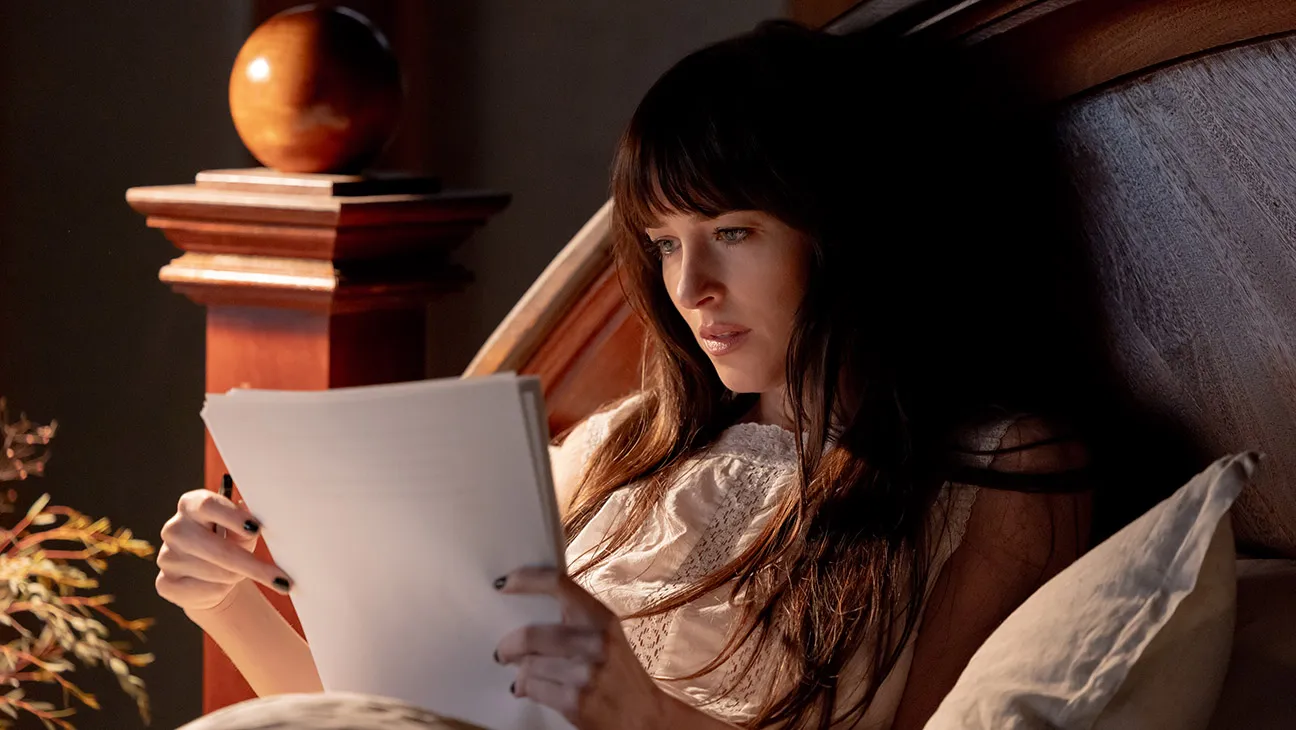
Which sounds kinda fun, right? And indeed Verity — directed with straightforward competence and a faint wry smirk by Michael Showalter and adapted by screenwriter Nick Antosca (Apple TV’s Cape Fear series) — is a mild lark for its first hour. Dakota Johnson, deadened of voice and dewy of eye, plays Lowen (Hoover’s character names are among the silliest aspects of her work; there’s a kid named Crew in this movie), a published but under-read novelist who is drawn by money and curiosity to snowy Vermont to complete an odd task. She’ll help finish, or really ghostwrite, the final few novels of Hathaway’s Verity Crawford (again, dumb names), who is mute and paralyzed following a car accident.
Okay, Lowen may also have been lured in by the enticement of Verity’s hunky husband, Jeremy, played by a fine-wine Josh Hartnett. When sifting through Verity’s notes in her sleek home office, Lowen discovers a secret manuscript for a shocking autobiography (of sorts), in which Verity divulges perhaps the most sinister secret possible.
So we’ve got a lavishly appointed modernist mansion, a smolderingly grieving husband, and some literary intrigue. That ought to all add up to something pulpy and propulsive, even if the excerpts of Verity’s prose read like Robert Langdon is about to jump out from behind a corner and yell “Symbology!”
Perhaps keen to that silliness, Showalter fills the early stretch of the film with amusing details. There are cameos from the likes of Gayle King, Alex Cooper and Sean “Hot Ones” Evans, all of them interviewing Verity about her writing process. We see Lowen lying around and languidly pulling on her vape (she’s a JUUL user) instead of doing any writing, which will be all too relatable for many scribes in the audience. And then there are the smash cuts to Hathaway comatose and staring into the middle distance, gaunt and drawn as if we’ve just freeze-framed on Fantine mid-song.
It’s a gas, and Hartnett, Johnson and Hathaway (the latter in flashbacks) initially know just how to pitch the hot-and-bothered, creepy melodrama of it all. But alas, eventually all involved have to get down to business and actually contend with the plot beats of Hoover’s story, which is when the movie careens off a cliff, plumetting past so-bad-it’s-good and crashing on the rocks of agonizingly dumb.
I won’t spoil what’s actually going on in Jeremy and Verity’s Japandi-meets-’70s-coke-den house of horrors, but the revelations provoke so many logical questions that one leaves the theater stupefied and frustrated rather than giddy.
There’s a bad clash of intentions happening here. Showalter, who has undergone a surprising career shift from alt comedian to journeyman director of women’s pictures, clearly wants to try his hand at a lurid erotic thriller. Some of those trappings may be found in Hoover’s novel, but she ultimately seems more interested in delivering a shivery, sophisticated treatise on the manipulations of the writing craft, its ability to sell fact as fiction and fiction as fact. Those two impulses may have agreed with one another in something with a more polished pedigree; in Verity, though, their intersection loudly clanks. The movie is neither sexy nor smart, despite the objective hotness and intelligence of its performers.
Though, it perhaps must be said that Johnson’s glazed-over, murmuring style of line delivery does grow grating. I’ve long defended her particular technique, typically finding something subtle but dynamic rippling underneath her placid exterior. But this time around, one sadly has to disagree with Lowen when she says she isn’t actually bored, she just has “resting bored face.”
Because Johnson seems genuinely checked out here, barely committing to anything in the movie — she even pretends to eat a slice of pizza like she couldn’t be bothered to figure out how real people eat pizza. That apathetic approach, which starts off pretty funny, becomes increasingly vexing, especially when the film takes a turn that requires some actual fire from Johnson’s performance.
Verity on the whole, with its shoulder-shrug of an ending, seems dismayingly uninterested in actually giving us a good story. Instead, it creates a few moments of effective mood and figures the job done well enough. Like Verity’s writing, the film simply bandies about a handful of clichés without giving them any original spin. It’s an airport novel you’d leave on the plane, an in-flight movie you’ll likely doze off to someday, borne aloft toward somewhere I hope is far more interesting than what’s wanly flickering in front of you.
