


Unlock the White House Watch newsletter for free
Your guide to what Trump’s second term means for Washington, business and the world
Donald Trump pressed his Ukrainian counterpart Volodymyr Zelenskyy in a call on Sunday to halt Kyiv’s strikes on Russian refineries over concerns that the attacks are exacerbating a global diesel shortage and pushing up prices, according to people familiar with the call.
The US president’s main message was about “diesel, diesel . . . diesel” and urging Zelenskyy to order his military to cease their drone and missile attacks, a senior Ukrainian official who was on the call told the FT.
Another senior Ukrainian official familiar with the call said that Trump emphasised he was very worried about the rising price of diesel and wanted to ensure Russian supplies could reach the global market to provide relief.
The White House did not immediately respond to a request for comment.
Zelenskyy said in a statement after the call that it had been an “important conversation” and that his meeting with Trump on the sidelines of the UN General Assembly this week “could change a lot”. His office said the meeting was expected to take place on Tuesday.
“There is diplomatic momentum,” he said without elaborating.
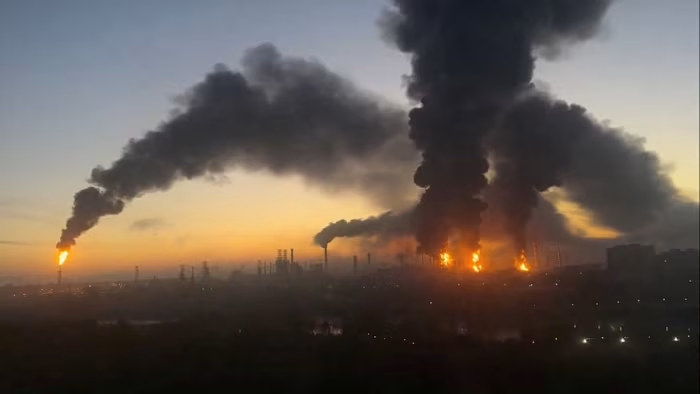
The call came hours after Ukraine hit Moscow with what Russian authorities said was the largest-ever drone attack on the capital, setting a major oil refinery ablaze and killing at least two people and injuring 20 others.
Moscow mayor Sergei Sobyanin said air defence shot down 450 drones as they approached the capital.
In a sign of Trump’s growing frustration, the US president on Monday posted on Truth Social that Russia had “lost control of its Diesel Oil Industry”, adding: “This ridiculous and never ending War with Ukraine must be ended.”
Russia has continued its deadly missile and drone strikes on Ukrainian targets, hitting energy infrastructure, petrol stations, commercial warehouses and other businesses.
US diesel prices hit a fresh record of $6.51 a gallon on Monday, up more than 70 per cent since the Middle East conflict broke out in February.
The latest surge has sent a burst of inflation cascading across the US economy just weeks ahead of US elections as truckers and farmers are forced to pay unprecedented prices for fuel.
Some Republicans in the country’s agricultural heartlands have floated a ban on diesel exports as farmers are squeezed by soaring fuel prices just as the autumn harvest season kicks off.
“High diesel prices ARE KILLING FARMERS INCOME,” Iowa Republican senator Chuck Grassley wrote on X on Saturday, while calling for such an embargo.
Trump claimed last Monday that Ukraine and Russia had agreed to refrain from striking each other’s energy facilities while attributing the global rise in diesel prices to the war rather than his conflict with Iran. But Ukrainian officials told the FT then that the US president had got ahead of himself and that no ceasefire had been agreed.
Zelenskyy clarified after Trump’s statement that Ukraine would honour a reciprocal ceasefire if the US and other partners could ensure that Russia did the same.
It is not clear whether the Trump administration has made similar requests to the Russian side to halt attacks on Ukraine’s energy infrastructure.
Russia has not commented on Trump’s efforts to secure an energy ceasefire. Vladimir Putin, Russia’s president, is unlikely to agree before the end of this coming winter, when his forces are planning a devastating aerial bombardment of Ukraine’s energy infrastructure, according to people briefed on his thinking.
The Russian president believes his forces will capture the remaining areas of the Donbas, a key frontline region in eastern Ukraine, and saw the air campaign as leverage to extract further concessions from Kyiv, the people said.
Putin said this month that he had ordered Russia’s armed forces to prepare a mass air-strike campaign in response to Ukraine’s attacks on Russian energy infrastructure. “They are hitting ours. They’ll get an answer. That’s basically how it is,” he said.
Previous US efforts to broker a halt to attacks on energy infrastructure have failed.
Diesel has become a political liability for the president ahead of midterm elections, as infrastructure damage caused by his war with Iran and the Russia-Ukraine conflict squeezes supply, pushing prices to unprecedented levels in the US.
But a recent assessment by Ukraine’s KSE Institute found the US-Iran war had a far bigger impact on global diesel and oil and gas supplies than Ukraine’s drone strikes.
One senior Ukrainian official said they believed Trump could be holding up implementation of the sweeping Russia sanctions law he signed last week as leverage to persuade Ukraine to stop its attacks on Russian energy infrastructure. But the official said that Trump could also use the sanctions as leverage against Russia to try to push Moscow to engage with Kyiv and restart direct negotiations.
The Trump administration has tended to favour using sanctions as instruments in negotiations rather than automatically implementing them.
Zelenskyy, who was travelling to New York on Monday, said in a statement: “Russia is not backing down from its escalation and is sending many signals that it is ready to expand the war.”
He urged allies to “continue pressuring” Moscow to end the conflict and argued that the Ukrainian drone and missile campaign was “part of the pressure that is actually working and the world can feel it”.
“But diplomacy must work in parallel,” he added.
Additional reporting by Myles McCormick in Washington
