


Unlock the Editor’s Digest for free
Roula Khalaf, Editor of the FT, selects her favourite stories in this weekly newsletter.
This article is an on-site version of our Unhedged newsletter. Premium subscribers can sign up here to get the newsletter delivered every weekday. Standard subscribers can upgrade to Premium here, or explore all FT newsletters
Good morning. Unhedged expects that there was a general sense of relief at the Federal Reserve and the US Treasury as the 10-year Treasury yield fell yesterday. That yield is now 6 basis points below 5 per cent — the level at which the contest between the bond and stock markets goes to a penalty shootout. Still a bit of extra time to play, then. Send us an email and tell us how much: [email protected].
The QT endgame at the BoE
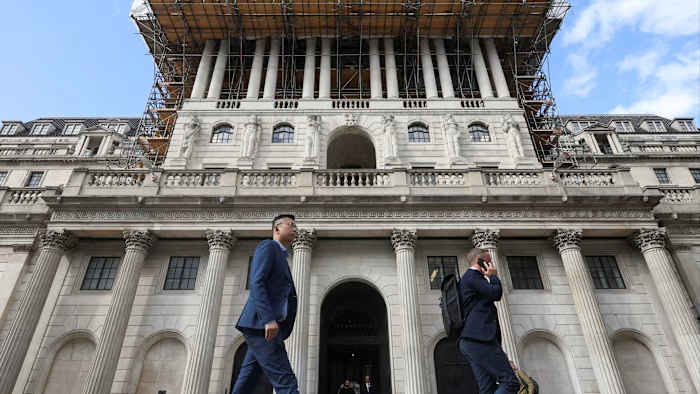
Yesterday, the Bank of England held interest rates at 3.75 per cent, while signalling there may be rate rises to come. It is one of only two G7 central banks that hasn’t raised rates since the start of the Iran war; the other is the Bank of Canada, and it’s facing a very different kind of shock. The BoE looks like an outlier, and not for the first time.
For proper finance nerds, there was an even more interesting announcement: a change to the balance sheet strategy. Until now, the BoE has run one of the most aggressive balance sheet reduction programmes of the major central banks that deployed quantitative easing — bond-buying as a policy-loosening tool. The reasons are simple: the maturity profile of the bonds it acquired meant it would have taken nine years to reduce its portfolio by half; and carrying that portfolio entailed a lot of interest rate risk, with very real fiscal implications.
Yesterday the BoE said it would hold a large share of its bonds — about £341bn of the £488bn portfolio — to maturity, rather than sell them. This is a big step back from the previous hard-headed approach to balance sheet normalisation. It will reduce the quantity of debt that investors will need to absorb over the next few years, which might provide some marginal relief to the pressure on long rates.
The BoE also said it is considering selling the remaining £147bn or so of gilts to the UK Debt Management Office, instead of the market. This will allow the DMO to decide what to do with that debt. For instance, it could redeem it and issue more at the short end where there is more demand. It also means there will again be just one public sector seller of gilts to the market, which may be preferable from the perspective of market efficiency and overall fiscal-monetary harmony.
One might argue that this is all just window-dressing. In economic terms, it’s not likely to make much of a difference. The accounting framework for the asset purchase facility — the vehicle in which the gilts are held — is unchanged; HM Treasury will still need to make quarterly payments to the BoE as long as the market value of the gilts is below the cost of the bank’s liabilities (the reserves created to purchase the gilts).
But these changes should take some of the air out of part of the criticism the BoE has received. Yes, so long as yields keep rising, the Treasury will have to make the central bank whole on its losses. But fewer of those losses will be crystallised by sales, and the argument that the bond sales are big enough to depress the market will be even harder to maintain.
Governor Andrew Bailey has often asserted that when the final accounting is done, the lifetime impact of QE will be positive. He may well be right. But his efforts at trying to convince the public — and increasingly sceptical politicians — of this have failed. The BoE’s unresponsiveness to critique was becoming a risk to central bank independence.
There may still be some who hold out hope for a full stop to QT sooner than 2034, the new end date for the strategy. Over the summer, a number of analysts proposed a BoE permanent bond portfolio as a way of supplying the stock of reserves. But the only permanent bond portfolio the central bank is interested in is the one they’ll maintain to match the value of currency in circulation — a topic I covered in detail for Alphaville on Tuesday — which will come initially from £120bn of the £341bn in retained gilts. For anyone looking to BoE to take on the role of structural buyer of gilts, this is as good as it gets.
Perhaps, at last, QT can proceed “in the background”, as the Monetary Policy Committee wished when it started the process.
One good read
American college is incompatible with itself.
FT Unhedged podcast
Can’t get enough of Unhedged? Keep following Rob Armstrong and Katie Martin’s incisive and unfiltered analysis on the Unhedged podcast, a twice-weekly, 15-minute lively dive into the latest markets news and financial headlines. New episodes every Tuesday and Thursday.
Recommended newsletters for you
Due Diligence — Top stories from the world of corporate finance. Sign up here
The AI Shift — John Burn-Murdoch and Sarah O’Connor dive into how AI is transforming the world of work. Sign up here
