



In our recent Mexico and My Money survey, more than seven in 10 respondents indicated they have a local bank account, but only one-fifth of respondents said they had a Mexican credit card.
Why the large gap?
Presumably, those living in Mexico without a local credit card continue to use cards issued by a foreign bank. Below, I take a look at why foreigners tend to skip this financial product in Mexico, how a foreigner goes about getting a Mexican credit card, and when one might actually be useful.
Mexican credit cards fall short on value
Foreigners living in Mexico who use credit cards issued by a foreign bank have plenty of reasons to hold onto them.
U.S. and Canadian cards offer customers an array of lucrative perks. These can include cash back on purchases, points that can be exchanged for cash at retailers, airlines and hotels, access to private airport lounges, and more.
In addition, many foreign credit cards have no annual fees or surcharges on purchases abroad, making them suitable for foreign residents living in Mexico permanently or part-time.
Perks aside, another reason to hold onto a foreign card is the cost of credit if you carry a balance. Mexican credit cards have exceptionally high interest rates.

A recent study by Banxico, Mexico’s central bank, found that standard Mexican credit cards carry interest rates from 60% to 85% annually, while entry-level or co-branded retail credit card rates are frequently in the 100% to 125% range.
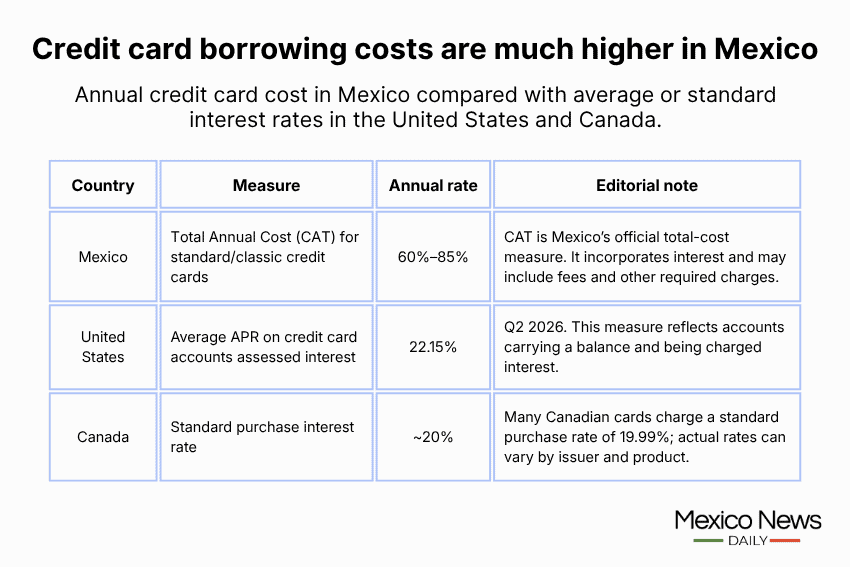
According to U.S. Federal Reserve data, the average credit card interest rate for U.S. cards is 22%. In Canada, the average sits at around 20%.
So, why is there such a massive difference between the U.S. and Canada on the one hand, and Mexico on the other?
In Mexico, there is no legal limit on what banks can charge on credit cards. If you ask a local banker why they charge so much, you’ll likely hear about delinquency rates being higher in Mexico, forcing banks to charge more to cover their risk.
But the facts don’t support this argument. Delinquency rates in Mexico have fallen precipitously over the past 15 years, while interest rates have remained stubbornly high.
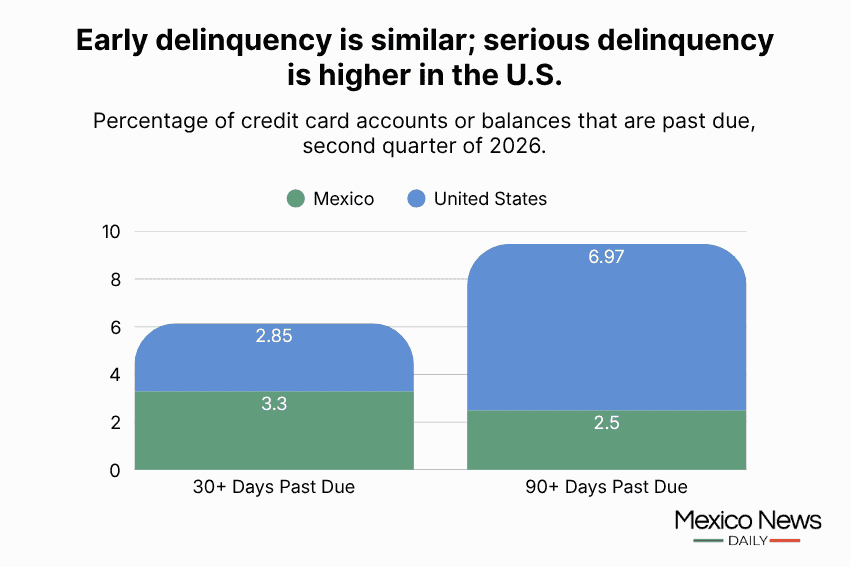
For the second quarter of 2026, about 3.3% of Mexican credit card accounts were delinquent (30-plus days past due), according to Banxico. This is only modestly worse than the U.S. rate of 2.9%. For seriously delinquent accounts (90-plus days past due), Mexican cardholders score better, with 2.5% overdue in Mexico versus 7% in the U.S.
In fairness, Mexican banks are often “flying blind” when compared to their U.S. counterparts. With over 50% of Mexican workers earning wages informally, it’s difficult for banks to evaluate credit risk. Their solution, if you can call it that, is to treat everyone as high risk.
Mexico and My Money: What you told us about your personal finance habits and hang-ups
Finally, recovering money on bad debts is nearly impossible in Mexico’s slow and costly legal system. To compensate, banks price the risk upfront.
Besides high interest rates, Mexican credit cards are also known for steep annual fees and exorbitant charges for late payments.
Add it all up, and it’s not a compelling value proposition, if we’re being honest.
When a Mexican credit card is useful
With all of the advantages of foreign credit cards over Mexican cards, you may think this is an open-and-shut case. But there are a handful of times when you may find a local card practical to have.
For example:
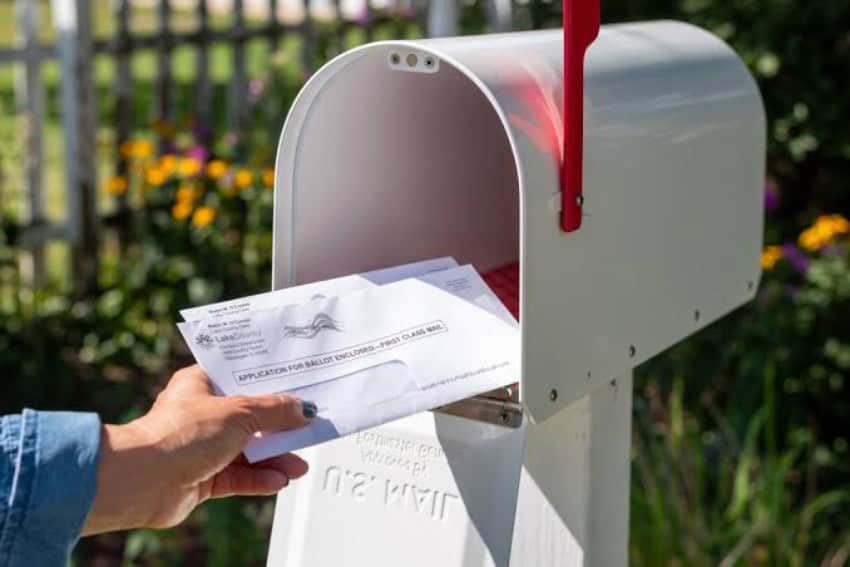
If you no longer have a U.S. mailing address: Without a verifiable residential address in the U.S. or Canada, major international banks generally will not issue you a credit card in Mexico. You’ll need to seek credit from a Mexican bank following the steps outlined above.
If you shop on Mexican e-commerce sites: If you’ve ever tried using a foreign card to make a purchase from an e-commerce website in Mexico, it can feel like traveling to hell and back. Many domestic companies haven’t considered this use case, so it can be difficult, if not impossible, to buy with a foreign card. The rare exceptions where things go smoothly are Amazon.com.mx and Mercado Libre.
If you pay for utilities online: Utilities and internet providers are the service companies most likely to decline foreign credit cards. Expats who lack a Mexican credit card typically end up paying these bills in cash at Oxxo or via electronic transfer from a local bank account.
If you are applying for a mortgage in Mexico: It’s typical for Mexican banks to require a detailed local credit history to be eligible for a mortgage. Having a Mexican credit card helps you build that history and improves your chances of getting a loan.
Getting a credit card in Mexico can be difficult
Mexican credit cards have historically had high barriers to access. Stung by massive customer defaults during the 1994 Tequila Crisis, traditional banks have remained cautious about lending.
A newly arrived expat can’t simply walk into a Mexican bank and open a credit card account if they lack a credit history in Mexico.
Since a credit history built abroad isn’t applicable in Mexico, it’s typically necessary to open a bank account and develop a local credit history before it’s possible to access credit from a traditional Mexican bank.
Mexico and My Money: Do foreign residents in Mexico need a local bank account?
In the past few years, the rapid rise of venture-backed fintech firms operating here has begun to shake things up.
Nu Mexico (which recently converted from a fintech to a full bank) was one of the early pioneers. Since entering Mexico in 2023, the firm has expanded exponentially, marketing debit accounts and credit cards to Mexicans long ignored by the country’s traditional banks.
As of this year, there are now 6.6 million Nu Mexico credit card customers, the third highest in Mexico (up from zero in 2020).
For those determined to get a Mexican credit card, requirements vary, but the list below is fairly standard. An applicant should:
- Have proof of residency in Mexico with an FM2 or FM3 card (temporary or permanent residency visa).
- Have an original passport.
- Have verifiable income or financial assets. Pay stubs or a history of monthly deposits in a local bank account are both acceptable options.
- Have proof of a local bank account. How long it needs to be active before applying for credit varies by bank. For some, a few months may suffice, while at others it may take years.
- Have proof of address in Mexico (such as a recent utility bill from CFE).
- Have an RFC number (taxpayer ID in Mexico) issued by SAT.
- Have a CURP number.
- Be at least 18 years old.
Pro tip: Major department stores offer easier access to credit than banks — whether you are a foreigner or a Mexican citizen. This has become a popular way for new expats to start building their credit history in Mexico if they are denied credit by a traditional bank.
From tipping to moving money into Mexico from abroad, check out more from MND’s “Mexico and My Money” archive.
MND writer Dawn Stoner is reporting from Guadalajara.
